![]() |
|||||
|
|
Home > About Us > Corporate Citizenship > | |||||||
| Volunteers Help Solve a Gen-Y Problem: Managing Expectations to Keep College Kids in Engineering July 2005
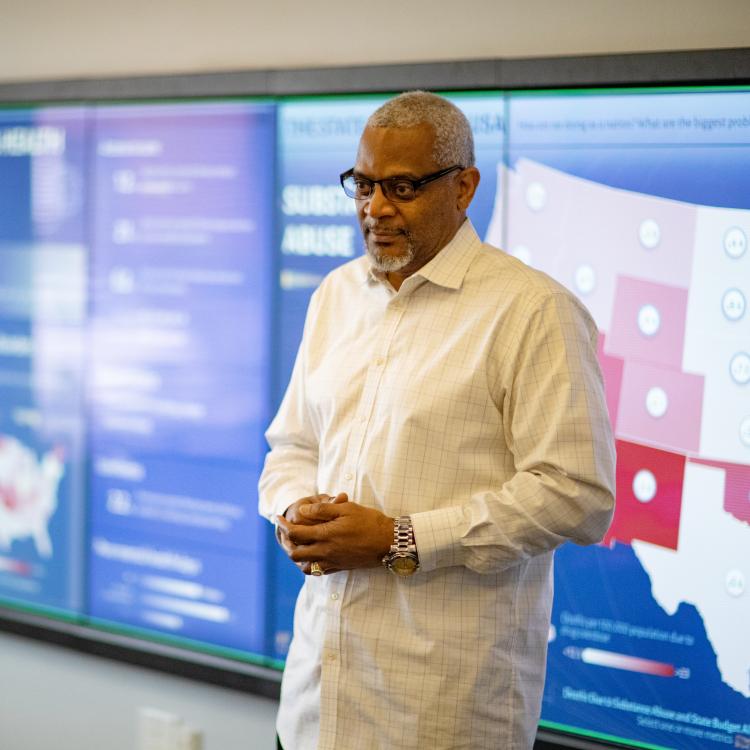
When staff from MITRE's office in Hampton, VA, began discussing with local universities how they could collaborate on research projects, the problem of keeping kids in school came up. Students in computer science classes were dropping out before completing their first two years. They weren't motivated and had unrealistic expectations. So MITRE's Tidewater Research Council (TRC) in Hampton worked with local schools to develop an outreach program that is turning the tide. The TRC is a local volunteer group that works to develop research programs between MITRE and its customers in the Hampton area. TRC members wanted to help college students succeed and become potential employees, so they set up MITRE's University Outreach Program for the Hampton area. "We can't just sit back and bemoan the fact that we're not seeing the kind of entry-level employees that we would like to have," says Mary Ann Malloy. Malloy is a lead software engineer and heads the University Outreach Program. "We need to work with universities and expose students to the breadth of engineering activities that they could do when they get out of school." Her manager, Bob Cherinka, agrees. "The TRC's work in reaching out to universities and building an environment to bring in new talent is important to MITRE," says Cherinka. Outreach Program The Outreach Program includes a mentoring program, a collaborative research program, and an internship program. There is no cost to the universities for these programs. In addition to Malloy, other MITRE employees volunteer their own time with a portion paid by MITRE as "civic time." They include Mike Cokus, John Dahlgren, Cheryl Connors, John Kane, Gretchyn Melde, Chad Smith, Kevin Gunn, Helen Holland-Harris, Daniel Winkowski, Jeff Rowell, and Fred Potts. Malloy and her TRC associates set up the Mentoring Program with two local schools, Old Dominion University (ODU) and Christopher Newport University. One of the program's activities, "Professional in a Classroom," is applauded by university instructors because of the credibility an outside professional brings to the classroom. "Students will sometimes blow off the advice of an instructor because they see the instructor only in the classroom setting, but a real-life professional engineer is believable," says Malloy. "We tell students why they need to study some theory before they can work on interesting projects." Students Get Critiques from Industry Experts At Old Dominion, computer science instructor Janet Brunelle devised a new course to improve the retention rate of students, especially women. Called "Introduction to Computer Science," the course includes visits by industry experts who will also contribute to grading the students' projects. Says Brunelle: "Mary Ann Malloy recruited a team to come in and critique our students in four courses throughout the entire semester. Those experts are highly educated and can give real-world experience to my students through feedback and constructive criticism. A lot of computer science majors enter our curriculum thinking they're going to build a great Web page or program computer games. That's not how most of the real world works." Mike Overstreet, professor of computer science at Old Dominion, says that ODU graduates working at MITRE who come back to speak make a big impact. "They bring a perspective to the students that the faculty can't," says Overstreet. Other mentoring activities include career advice, colloquium talks, and an expert panel's mock review of computer science projects. For example, Mike Cokus, a MITRE senior software engineer, participated on a panel that reviewed new product ideas for ODU students. The panel graded the students on all aspects of their product ideas: technical, financial, marketing, even their presenting skills. After one team presented their idea, Cokus says he was "ready to pull out his wallet and invest in the students' idea." Cokus enjoyed the experience and felt it helped him get in touch with the latest education process. "It's a good opportunity to see students in action and identify recruits," he says. Collaborative Research Program The Collaborative Research Program helps university instructors identify good research topics for their seniors and graduate students. For example, John Dahlgren suggested that one student write his thesis on optimizing satellite communications by increasing throughput of different frequencies while minimizing cost. Dahlgren and Kevin Gunn mentored the student, who successfully presented his thesis in April. Internship Program The Internship Program gives relevant work experience to a student. "Too many of the resumes from students coming across our desks don't have any relevant work experience," says Malloy. "The internship also helps us see if this person would be a good fit for MITRE and vice versa." Marshall Huss, a junior at Christopher Newport University, is an intern at MITRE. Huss recently completed work investigating XML firewalls for the 2005 Coalition Warrior Interoperability Demonstration. When Huss first arrived at MITRE, he received a mentor for his internship and, just like a regular employee, was required to do a performance and development assessment plan. Based on this first successful experience, the Hampton office is currently looking into additional internships and student hires for the summer of 2005. "My work is really enjoyable," says Huss. "I have unlimited resources among the books, people, and knowledge here. There's no problem asking anybody a question, and I get as much help as I need." The volunteer work by the TRC is just one example of MITRE's commitment to giving back to local communities. For other examples, see the stories under Related Information below. —by David Van Cleave
Page last updated: July 21, 2005 | Top of page |
Solutions That Make a Difference.® |
|
|