Brandt Lomen

A Career on a Different Wavelength
Brandt Lomen
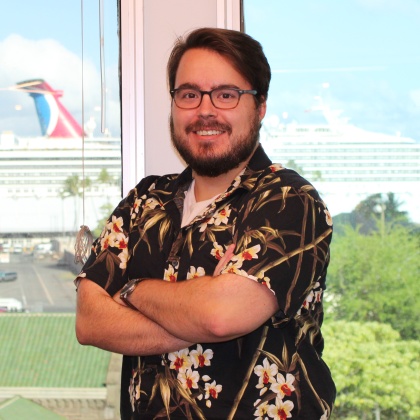
Growing up, Brandt Lomen thought about becoming a band teacher, so he got a job in a music store and learned to play 11 instruments. Today, the electromagnetic spectrum operations expert brings the same energy and focus to every project he takes on.
It’s an approach that gives Lomen an advantage in his work developing spectrum-dependent capabilities for warfighters, from wireless communications to position, navigation, and timing. Maneuvering across the range of electromagnetic frequencies—radio waves, microwaves, etc.—boosts resilience and effectiveness in systems vital to situational awareness, infrastructure protection, and more.
Lomen's goal is to shrink the size, weight, power requirements, and cost of electromagnetic systems to enable wider availability. Doing so takes outside-of-the-box thinking and determination.
"I don’t approach a problem wondering what I could do to solve it," he says. "I ask, 'why isn't the problem already solved?'"
Innovation for National Security
Lomen says conflicts around the world today demonstrate that "warfighters can’t wait for 100-percent successful technologies." When lives, time, and infrastructure are at stake, "imperfect capabilities are often more valuable than none at all."
A case in point: Lomen invented a novel, low-cost technology to address an unmet need for the military. His idea challenged conventional thinking in the spectrum operations field, but military operators recognized its value and potential impact.
"I encountered skeptics, but I persisted," he says. "Research validated the technical method, and I obtained MITRE funding for independent R&D."
He assembled a cross-disciplinary team of radar, electrical, and mechanical engineers to rigorously test and prototype the capability. Collaborating with the U.S. government, the process took just six months. The technology was then transferred to both government and industry.
Lomen’s experience speaks to what sets MITRE apart from industry: We develop and transfer innovations that benefit the nation’s security and prosperity, placing mission outcome as our highest priority.
"It's not about revenue or sales," he says. "Our goal is to get technology into the hands of warfighters faster to help them succeed. We collaborate with government, industry, and the academic community to make that happen."
Charting a Career Path
Born and raised near Anchorage, Alaska, Lomen moved to New Hampshire to work for a defense contractor after earning a bachelor’s in electrical engineering from University of Alaska Fairbanks. He stayed for five years, immersed in one project, while also earning a master’s in electrical engineering from Worcester Polytechnic Institute.
"I learned so much in that first job out of college, but I was ready to branch out and develop new skills," Lomen says. He found that opportunity in radar technologies at MITRE in 2023.
“The job description didn’t match my experience exactly, but I knew how to use radar, so I took a chance,” Lomen says. “It turned out to be a great fit.”
He later joined the National Security Engineering Center, the federally funded R&D center we operate to support the country’s national security and intelligence agencies.
Lomen’s peers took notice of his work.
The Association of Old Crows (AOC), a professional non-profit association of electromagnetic warfare stakeholders, recently recognized Lomen’s seven years of advancing spectrum capabilities. He received an AOC Future 5 Award for professionals under 30 “who actively innovate and strive for excellence as they build their careers in electromagnetic warfare, electromagnetic spectrum operations, and information operations.”
An Invaluable Perspective
Today, Lomen is based at MITRE’s Hawaii site in Honolulu. He largely works on Oahu, supporting joint warfighter efforts in collaboration with the U.S. Indo-Pacific Command.
“Being here where multiple government sponsors work is invaluable,” he says. “I’m an engineer, so I understand how the technology works, but now I get to see how it helps the joint warfighter community—and what needs improving.”
He and his family left the Boston area in early 2025, happily trading New Hampshire blizzards and mud season for Oahu’s warm weather and beaches.
“My wife, daughter, and I make a point of going to a landmark and a different beach whenever we have free time,” Lomen says. “People are so friendly here. We love it.”
“I sold my snowblower a few days before we moved. I was happy about that.”