
Strengthening Communities
Making a safer world starts with strengthening communities.
It starts in upstate New York, where MITRE is training first responders to use uncrewed drones; and in Chula Vista, California where officers are already taking to the skies. It starts in McLean, Virginia, where virtual reality training creates responsive and respectful police; and in Chicago, Illinois where the Digital Crime Investigation Platform helps local investigators track down cybercriminals.
Our mandate to serve the public good means offering first responders real-world answers that can be implemented quickly and at little or no cost. These aren’t wild ideas or pilot projects but proven, reliable solutions adapted for local needs.
We can help first responders incorporate the same uncrewed aerial systems used to fight foreign drug cartels and create counter-UAS technology to protect prisons from smugglers. We can reduce the risk of police pursuits by enabling vehicle tracking from the air and give firefighters a bird’s eye view of the blaze using techniques we learned defending the southern border.
Whatever the need, MITRE can help share the technological future of local emergency response.
Our Impact
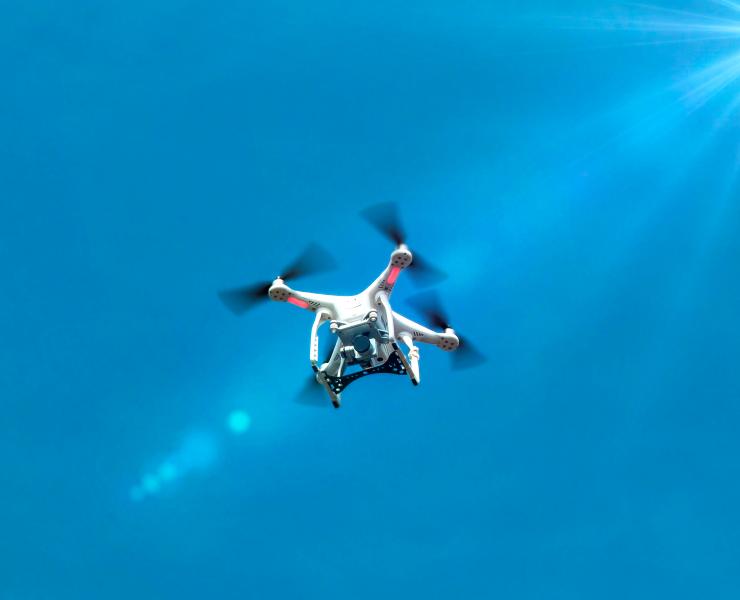
In Chula Vista, California. A fast flying drone might be the latest advance in local emergency response. The San Diego suburb is testing a new type of first responder, an unmanned aerial vehicle or drone. A dispatcher can launch a drone from inside police headquarters, giving responding police officers, fire chiefs and others a bird's eye view of potential incidents providing clear and sometimes lifesaving information and perspective to first responders. Drones are everywhere, from backyards to battlefields to rural farms to urban landscape. At MITRE we see the promise of this new technology, and we're excited about it. But we also understand the threat that it poses to public safety. The FAA may prohibit drones from flying over stadiums during sporting events, but that didn't stop Tracy Mapes. The kids behind the video didn't hide who they are, but what they did above the CU versus Arizona. Game is being considered dangerous. Drone in a in a stadium of this size could you know it could carry a bomb or some explosive device that could crash into the crowd and injure people. Which is why MITRE developed another drone program, Carpe DRONVM. Modifying an application originally built to help protect the U.S. Air Force. It can enable law enforcement to identify, monitor and track unidentified drones through a standard cell phone app. The app combines advanced sensors and some of MITRE's proprietary artificial intelligence algorithms to enable law enforcement to quickly create a counter drone strategy if and where it's needed. And to power future drone applications. MITRE's new first responder drone range serves as a premier location to test, experiment, train and showcase drone technologies for the nation's first responders. The threat and promise of drones are here to stay, and MITRE wants to work with fire departments, law enforcement agencies, the federal Aviation Administration, all the stakeholders to make sure that we're creating a safer flying future for everyone.


- Ladies and gentlemen, we're so glad you've joined us today for MITRE's Fire/Rescue Drone Summit. I'm Steve king, a senior manager here at MITRE. I'd just like to mention that we will be recording this session. That's to allow those who are unable to attend this morning, an opportunity to participate a little later on. And now I'd like to turn it over to Yosry Barsoum, our vice president at MITRE Center for securing the Homeland. Yosry.
- Thank you, Steve. I'd like to welcome everyone to the Fire/Rescue Drone Summit. As Steve said, I'm Yosry Barsoum, I'm vice president and director for the Center for Securing the Homeland. As MITRE is committed to solving problems for a safer world in support of the entire Homeland Security Enterprise. Fire and Rescue community is a critical stakeholder in the Homeland Security Enterprise. They keep our community safe, respond to emergencies and ensure the wellbeing of local communities. As the use of Uncrewed Aerial System has become pervasive, and that has opened new opportunities for innovation. These innovative technologies are used by first responders to keep our nation safe during extreme weather events, wildfire, or targeted violence events. As we started this initiative earlier this year to explore the use of uncrewed systems for the first responders. And we held a similar summit a few months ago with law enforcement community. And we have seen the application of Uncrewed Aerial Systems with the law enforcement community. I'll give you just one example in Chula Vista, California, that police department has been at the forefront of deploying uncrewed systems as an augmentation to the mission. They launched their program back in 2018 and the Chula Vista Police Department drone as first responder also known as DFR Program provides airborne support to public safety operations. It is safe, responsible, transparent manner to protect the public, preserve the peace, and reduce response time and increase the overall quality of life. They use UAS to evaluate the resources needed, prepare proper tactical response and increase safety for the first responder and the public. A few member of the team who created the DFR are now working with industry, and you'll get to hear from them later today on the industry panel. Similar innovation for the fire and rescue community is possible as we have seen it with the law enforcement side. we could do more to support the fire and rescue community and advance these capabilities. So the purpose of today's event is really to bring the fire and rescue community representatives from that community, industry representatives and the Department of Homeland Security to illuminate the needs of the fire rescue teams and advance these solutions for mission applications. As you know, serving in the public interests MITRE is committed to driving forward the notion of whole of nation approach working along the fire and rescue teams and industry. And with that, it's my absolute pleasure to kick off the program with a fireside chat with Congressman Michael Guest moderated by our own Steve king. Over to you, Steve.
- Good morning to everyone. I'm Steve king. I'm a senior manager here at the MITRE corporation. It's my great pleasure to introduce Congressman Michael Guest today. Who's joining us for a fireside chat style keynote address, and I really appreciate it. Just to give the audience a little bit of background. I wanted to mention a value Congressman. You were a district attorney for Madison and Rankin counties in Mississippi. You earned a record for fighting for Mississippi's families by prosecuting criminals, and you've taken that same spirit and determination to Washington D.C. to fight for Mississippi in the United States Congress. You're now serving your second term and represents the third district in Mississippi. Relevant to today's discussion, you currently serve as a vice ranking member, the committee on Homeland Security, where you're working to protect our entire nation from foreign threats. Which is something I wanna ask you about in a couple of minutes, but more recently you've authored the Unmanned Aerial Security Act, that's H.R. 4682, for those who wanna look it up. So the issue of public safety use of drones is clearly an area of interest to you, and it leads me to our first question for you. So you introduce the bill in Congress, the UAS Act, and that prohibits the us Department of Homeland Security from operating or purchasing foreign made drones. So why do you feel that this is an important issue?
- Well, you know what we've seen over the last particularly several years started really over a decade ago is we're starting to see more unmanned aerial air systems used, particularly by the Department of Homeland Security. We know that there are now used a lot of times by local law enforcement, by first responders, search and rescue that you mentioned for a number of purposes that might be... I think earlier we had a brief conversation about wildfires. We know that we've used those when we've had natural disasters, hurricanes, tornadoes, We've used those when we are looking for maybe individuals who have become lost in wooded areas. And so there are such a large number of possibilities for this new technology, but with any new technology, there's always things that you wanna be able to protect the information, protect the data. particularly as it relates to the Department of Homeland Security. This bill was specifically limited to that agency, but we know that over 75% of commercial drones that are sold here in the United States are manufacturing in China. We've seen reports, and we know that there exist the possibility for data to be stolen. So when the information is being transmitted, actually from the drone to the user, that there's the possibility of that drone to be stolen. Some nefarious country, particularly in this case China, would have the opportunity to have access to that information. And also there would be the possibility of potentially the Chinese Communist Party being able to take control of those drones and cause those drones to crash or become operable. And so that is particularly important in the Homeland Security Department of defense RAMP. And so we thought that it was important for us as Congress to do everything that we could to make sure that those communications are safe and that the devices that we're using, that that information is not being stolen, not being siphon off by other countries. And so that was the reason for introducing the legislation. It was bipartisan legislation, it came out of the House overwhelmingly with bipartisan support. That bill has now been sent to the Senate. And we're hopeful and optimistic that between now and the end of this Congress, the bill will pass the Senate and hopefully make it on the president's desk.
- Well, that's wonderful. And we've seen states coming out with their own, at the state level, similar legislation, limiting the use of different drones for public safety to US manufactured drones as well. And I asked this sort of begs the question, your bill was very much focused on the US Department of Homeland Security, but what about local fire and rescue departments across the country, should they also consider not using foreign made-
- Oh, most definitely. And so while our legislation was somewhat limited in scope and what we did want to do is we didn't want to penalize local law enforcement search and rescue who may not be able to buy some of the lower price drones to still have access to that. But I think is definitely something that we need to be looking at. And we are making a big push here in Washington, a big push in Congress to see that not only are the devices manufactured here, the drones themselves, but the components that we're getting to put in these unmanned aerial air systems, that those also are manufactured here domestically. We've gotta challenge ahead. We know that many of the components are manufactured overseas, and those components then are often assembled here, but we've gotta do a better job of actually manufacturing the components. This has a Homeland Security implication, national security, you are talking about the Department of Defense, making sure that their drone fleet is safe, but I think we also wanna protect our first responders, our law enforcement, our fire, our rescue, to know that the drones that they're flying, that the information that they're receiving is going to its destination. And we do not have to worry about some foreign power or some foreign government being able to intercept those transactions.
- That's terrific. Thank you. I know that's a topic of conversation that will come up later in this summit. And it's certainly one that I hear about regularly when I go out and meet with first responders around the country on the topic of drones. In fact, I recently had an opportunity to visit your Alma Mater Mississippi State University, which has a as I'm sure a 70 year history in aviation research at Raspet, the Flight Research Laboratory down there. And I see them continuing this tradition, research, development, testing, and evaluation of unmanned aircraft systems. So I was just curious if MSU is where your interest in this important topic of drones began, or is there more recent impetus for the introduction of the UAS Act?
- Well I will tell you that I'm extremely proud of what Alma Mater Mississippi State University is drew on the research and development side. They are working with the Department of Homeland Security, working with the Department of Defense, as we are looking to see what we can do to make drones more efficient, more effective, to bring the calls down and also looking to what we can do to make sure, as we talked about earlier, that we're protecting those communications back and forth between the device and the operator, Mississippi state is partnering with 25 other universities. They're actually the lead university. They're also at Mississippi State University is the the FAAs Center of Excellence for Unmanned Aerial Systems. And so those two organizations are working very closely with one another. And so I will tell you that I've had the opportunity to visit their facility, to see some of the things that they are doing to talk to some of the people who are working there. And I'm extremely impressed with what they are doing, not only now, but what they are talking about doing in the future. This is a developing technology. We see that drones are getting better, they're getting faster, they're getting cheaper each and every year. And so some of the things that we're going to be producing five-10 years from now are gonna make our current drone fleet obsolete. And so we wanna make sure that as we're doing that, particularly we look in the Homeland defense realm, we're looking in the Department of Defense realm, what are we doing to make sure that we are supplying them with that next generation, which is going to keep Americans safe? And we know that those next generation drones, ultimately at some point are going to be used by law enforcement, are gonna be used by fire and rescue. And so we're taking all those things into consideration in that development stage. But again, thank you for mentioning my Alma Mater, extremely proud of my bulldog and extremely proud of what they're doing at the Raspet Flight Center.
- Well, I think all Mississippians should be proud of the work going on there. I was very impressed. It was great opportunity to work with them. And you had mentioned the work, fire rescue law enforcement and others, and their use of drones to respond to 911 calls. And so I'm gonna asked sort of a delicate question here, maybe an unpopular one, and that is that, while the public safety benefits of the use of drones for public safety is abundantly clear, how do we ensure community support from the people who are concerned about drones conducting surveillance against innocent people?
- Well, I do think that that's gonna be a discussion we're gonna continue to have balancing individual's right to privacy versus the benefit that we know that drone coverage provides. And so a lot of that is going to be that make sure that the operators of these devices are using that for its intended purposes. We know that in the fire and rescue realm of being able to have eyes in the sky, being able to have a drone which can cover large areas is going to assist those individuals in finding whether it be a lost child or lost adult. We know that in the natural disasters, we can very quickly survey the damage I think of cases in which you have large events, outdoor events, such as sporting events, particularly maybe high target, major league baseball, national football, college football, large gatherings of individuals. The use of unmanned aerial systems gives law enforcement that force multiplier. They're able to see the picture much clearer, much broader than just strictly having boots on the ground. And so I think if we continue to use this technology for its intended purpose, that we're going to instill public trust into the technology that we're using. And again, I see this as a former prosecutor, I know of many of the advantages. I think of law enforcement who may be going out and having to execute a high risk search warrant, being able to have eyes in the sky to make sure that they know where individuals are, they're going to protect those individuals who are going to be executing those warrants. So there's so many advantages, so many great things that we're going to be able to use these devices for. And so we've just gotta make sure that we are not misusing this technology in any shape, form or fashion, because we want the public to have complete trust in the technology that we're developing and using.
- Absolutely. That's terrific. And we certainly, I'll go back a little bit, MITRE is a not-for-profit chartered to work in the public interest, and we believe there's an important role for research development in this area, but I'll turn it over to you and just ask, what guidance would you offer to us or to the broader UAS drone, the industry, the for-profit commercial companies, the academia, fire rescue community, folks who are looking to use drones in their daily operations, any advice you might offer to us? 'Cause you're certainly well versed in this topic.
- Well first wanna thank you for the role that y'all are playing in this important field. Again, this is a developing field. This is a field that's gonna have so many applications moving forward. We talk about drones being used in this field for search and rescue for Department of Defense, Homeland Security. I know that we've even talked long-term about phases such as Amazon using drones maybe one day to deliver packages. And clearly we're not there yet, but those are the things that we need to be looking toward the future on. And so having you having conferences where we're seeking the input of our first responders, working with people like the Raspet Flight Center that you just talked about. So I think I'm a huge believer in private public partnerships. So when we have non-profits government agencies and private companies all working together, when we're able to pull resources together, I think we're much stronger than when we take the go long attitude. And I think that that is where your group comes in and where they're so important. And so I'm very optimistic about what the future holds for unmanned aerial system. So I think that there are so many promising fields ahead, and I think we're just scratching the surface on this. And so we've seen the huge leap we've made in the last decade. What is that leap gonna look like in the decade to come? And y'all are going to be part of building that future. So thank you for what you're doing. And again, thank you for holding this important conference and having these conversations.
- Congressman, thank you very much for your time. I know how precious it is and I certainly don't want to hold you a moment longer. And so I'll just wrap this up and let the audience get onto our panel of fire chiefs and others that we've got, and just express my sincere thanks for your time and your interest in this topic. And we really, very much appreciate it. Thanks, sir.
- Thank you so much. Have a great day.
- Thanks indeed.
- Good morning everyone. Thank you. Congressman Guest and Dr. King for that presentation. We appreciate that Congressman Guest, your partnership and we look forward to working with you in the future. Again, good morning, everyone. My name is Brian Dorow. I serve as the Chief Homeland Security Advisor at MITRE. And as you can see, we're very interested in working with our first responder community and through the summit, we look forward to hearing from you getting your input as we move forward in different initiatives that we have underway. At this time, I'd like to introduce our distinguished panel. We have Fire Chief Dan Munsey, who has been with the San Bernardino Fire Protection District for over 25 years, rising from firefighter to paramedic to fire chief. Has a master's degree in public administration pulls the California state training chief officers certificate and is on the technology council chairman for the International Fire Chief's Association. Welcome Chief. We also have United Kingdom Senior Fire Chief Dane Lane. Now retired. He's hugely active in the first responder drone community and has been involved in various roles in the international realm. He's a board member for the Advanced Forest Fire Fighting Project and Director of the Search and Rescue Academy. Welcome, sir. We have Mr. Vic Misenheimer, who is the emergency management coordinator for Caldwell County in North Carolina, and has been in Caldwell emergency services since 2018. He has a background, includes as a former deputy sheriff with the Caldwell County and as assistant chief with the Sawmills Fire Rescue, welcome. We have Battalion Chief Scott Roseberry, who has 20 years of experience with the Garland Texan Fire Rescue. He has a bachelor's in emergency management and a master in public administration. Roseberry is a member of the International Association of Fire Chief Technology Committee, Department of Homeland Security First Responder Resource Group, and the FEMA Region 6 rack, welcome. And lastly, rounding on our panel. We have Mr. Richard Gatanis, who is a Public Safety UAS Subject Matter Expert, as well as a firefighter HAZMAT technician with the Southern Manatee Fire Rescue located in Manatee County, Florida. In 2015, Rich took over the role as UAS coordinator for the South Manatee Fire Rescue by creating the UAS program within his agency. Since then, his department has become a national leader in the developing and implementing policy and best practice for UAS response and hazardous materials and special operations. Again, everyone welcome to our panel. I'd like to start with the first question, Chief Munsey, how are you using drones for firefighting in your organization?
- Hey, good morning, everybody. I think there's five ways that we're doing it really. So the first would be we're exploring the use of suppression drones. In other words, using retardant ignition drones, we do have a full wildland camp. So our wildland crew is looking for safer ways to ignite fires, to combat the different situations we have. Monitoring and surveillance, obviously that includes mapping. We're exploring a couple partnerships with some heavy lift drones for logistics. And finally the fifth, I think, would be communications as part of a mesh network to ensure that we have communications in some of our comms denied environments.
- Thank you, Mr. Misenheimer, how are you using drones for firefighting?
- Again, thank you for allowing me to join this panel. Mainly for situational awareness on fire scenes, so everybody can have a common operating picture and it's monitoring extension on working structure fires and things of that nature. We've also been recently in conversation with the North Carolina Forest Service. They do have a lot of manned aircraft. So obviously there's has to be coordination with manned aircraft and unmanned aircraft, but mainly right now for situational awareness on fire scenes.
- Thank you for that. Chief Roseberry how about you?
- So we actually have an interesting situation in Garland and I'm a good person to reach out to on drone systems, 'cause we've had two drones and we've crashed both of them. But the first one we crashed it in an actual swiftwater rescue. So we were using it mainly for situational awareness and swiftwater rescues. And we in Garland, we're an urban center, so we're right next to Dallas. And we mainly have a lot of creeks we have like a lot of concrete. So when everything rains, it all floods downstream. So our creeks quickly rise. And then about once a year, we have a swiftwater rescue. So we were using it mainly for that. But the idea was HAZMAT situational awareness on fires, swiftwater rescues, you name it.
- Thank you very much. Rich, so Manatee.
- Yeah. Thanks for having me. And I apologize, they chose today to do the fire alarm testing here at our administrative office. So this may hear that going off in the background, but appreciate you having me on. So we've done some interesting things with drones specifically in the beginning, it was for situational alert type tool for our HAZMAT calls. And then we realized as we could do a lot more with these systems and just kind of an eye in the sky mentality. So we started figuring out ways to use these symptoms to be more part of the mitigation process. So we do remote metering monitoring with drones carrying rad detection, flammable gas, chem detection with the aircraft itself to do a lot of the down range work as well as for interesting tactics with decon. And we've done quite a bit of flammability testing to determine whether these systems could become problems before as opposed to solutions. So lot interesting stuff having down here, Manatee.
- Looks like it. Thank you for that. Chief Lane, we'll finish up the first round of questions with you. Again, how are you using drones for firefighting in the UK?
- Well, the UK, and first of all, I should thank you for answering me on here as well. Over two thirds of fire rescue services are now using drones in some way, shape or form, but I think it's true to say that listen to the other presenters there, very similar sort of story, first of all for situation awareness, then developing it into risk mitigation and so on. So it it's also relatively early days, I think in the UK to perhaps how elsewhere has been developing. And I think that's a point that Charles made earlier on, that this is developmental.
- Thank you. And just a reminder to our attendees, after each panel, we are gonna have the opportunity for Q&A. So please put your questions in the chat. So when we get to that part of the program that we can answer your questions. Chief Lane, I'm coming back to you for the next question. It's, why are international drone organizations like DRONERESPONDERS and international emergency drone organizations important?
- Well, I think picking up on the point that I made just given that we're still a relatively small island and it's useful to learn from other countries. And so both the international drone organizations like DRONERESPONDERS and EIDL provide forums where lots of feedback can be obtained. And the other way, as well suppose you've got a project like when I recently put forward and ask for advice. We need to be able to contact others, learn from others experience, and to fast forward it rather than make our own mistakes, we need to learn from others. And I appreciate really the work that in particular Charles has done. and vendoring cliques from France in organizing these forums without which I think be the much poorer.
- Good point. I think we all can agree this is such an emerging area in the more forms we have like this summit, we exchange ideas, the better it will impact all first responders. So definitely agree with you. Chief Munsey, what obstacles have you encountered when you're starting a drone drone program? I think you can share with our attendees as they start thinking about this area. I think obstacles are the key. What do you have to share with us?
- There's several. So first internally firefighters, the and shiny object, right? When UAS has became a thing, the first thing that our organization did is went out and bought a lot line assigned drones. Of course, our pilots were firefighters. So we are essentially taking firefighters outta the fight. That became a problem. The second obstacle, I think that the biggest one we're facing in the industry right now is that the UAS capability and our pilot's capabilities far out seed our authorization to utilize a lot of the platforms that we use through the FAA. And so we've been working with the FAA closely to make sure that we're looking for every avenue to create successful scenarios in which we'll be able to use UAS as much more abundantly that we're doing today. We recognize clearly that UAS is part of an efficient response force early detection, early suppression, early mitigation, and being able to do that in the line of sight fashion is something we need to overcome. We need to truly get into BVLOS in a fashion that works for first responders.
- I'm gonna ask, that's a good point with the Beyond Visual Line of Sight. Do you have any examples? Where do you see the fire service going in this area? I'm gonna ask question in the future, but since we're talking about now, where do you see this going?
- Well, we serve a large county, largest county United States at 22,000 square miles. So for perspective, I think you can take the six small states in the union put it within our borders. We're very spread out. So we have a very clustered metro area. But as you get out into our deserts, you literally could be three hours between stations. We need to have an overwatch ability first off to monitor our rail, our freeways, to be able to then modify the response. We need to use the drones to have a quicker response capability. For years counties like mine put millions and millions of dollars in their budgets for helicopters. And we look at the use cases for UASs and realizes that we can replace that. We recognize that we need to have autonomous drones and semi-autonomous drones that are operating independent from human. As we look at fire suppression, for instance, when I first started 28 years ago, they told me that the metric that we were gonna use is that we're gonna keep wildfires 10 acres or less 90% of the time. And what's interesting is I was looking back at a textbook that's almost 100 years old and that metric was there. And so what do we need to do today to keep wildfires 10 square feet or less, and that may be sound ambitious, but when you have the ability for early detection, early response control autonomously followed up by boots on the ground for that containment that I think that we're gonna create different scenarios for public safety to control some of our wildfires and respond more efficiently.
- Excellent points. Mr. Misenheimer, what about you with the obstacles? What have you encountered that you would share with the attendees, the audience?
- Well, obviously our program is just three years old, so to me it's still a new program and getting all of our responders within our response area to understand the capabilities and the limitations. And I know that's an educational issue, but I truly feel like, just as with manned aircraft and a FLIR, we're dealing with the same things with heavy tree cover when we're trying to go in to help locate a loss subject or airspace issues in certain areas. And obviously our responders that are not familiar with drone operations or aircraft operations don't understand that. So there's obstacles that we have to do if we're gonna be able to fly the missions that we're requested to do. So it's more of an educational issue. And until it's important to them, I don't know if they'll retain that information as far as what we can and cannot do.
- Any ideas on how to address that educational piece? 'Cause I think that's gonna be a concern of a lot of communities as they continue down this path. Any ideas to share?
- I just, I think outreach, obviously we have multiple volunteer departments within the county that we work with hand in hand and also we work with law enforcement and I think just getting an education piece out to them during their in-service or continuing education training is valuable for moving forward. It's just trying to get that information to those that'll listen to us.
- Thank you, sir. Chief Roseberry talk about obstacles. What have you encountered?
- Well, first of all, I wanna say Chief Munsey, I think we have cattle ranch in Texas as big as your county. I had several. Number one, funding. And we're probably medium size department. We have 11 fire stations, 270 firefighters run about 25,000 calls a year, but just funding for the drone program itself. In fact, the two we had, I went out and got donated through two different organizations. One was our local exchange club. They donated a drone to us. And then the second one was gonna give this organization a plug, the National Public Safety Drone Donation Program. They're going out and seeking funding from organizations and companies to help first responders get drones. And they're donating drones to first responding organizations. So it's a great organization. So funding number one, personnel. Like I said, we have 270 firefighters, 11 fire stations. We can't keep enough. we actually are our mandatory overtime almost every day. So we don't even have the personnel to run a drone system right now. We're short. And I think that's pretty much across the nation. Fire departments have a shortage of people. So who's actually gonna run this drone? I know fire departments that have a drone program, but it's just sitting on a shelf because they don't have the staff to actually fly it when they need it. The buy-in the culture, the culture in the department, the buy-in. Honestly, our second drone was crashed because they were treating it like a toy kind like Chief Munsey, said the little shiny new object. They were treating it like a toy as they were practicing with it at the station, they ran it into the fire station wall. And just trying to get that buy-in from me you need to find people that actually will take ownership of the program and take ownership of the drone. And realize that it's an asset, it's a tool, it's not a toy. So that, there's just a few of the hurdles that we're facing in the fire service.
- That you brought some good points, any advice, because I think there are a lot of both law enforcement fire service that may be well it's situational. We have a drone program, maybe it's in the back of our car or in the back of our truck. We'll put the drone up when we're told to put the drone up, but do you see a movement towards having dedicated programs? Can you have just... Certainly they're a tool, and I think everyone would say they're necessity now. They play a pivotal role in fire service, law enforcement services, et cetera. But do we need to move more professionalize this program so it's a dedicated program from your perspective?
- Yeah. I agree 100%. The problem is the funding. We go back to just where's the funding for it. Where's that land in the priority? Now, like the first drone we had, we lost it on actual water rescue. And unfortunately we didn't find the woman, she ended up perishing in the accident, but it did create a lot more buy-in 'cause some of the firefighters and frankly, one of the other battalion chiefs who was anti-drone at the time. Called me up afterwards and said, "Look, hey, I was the instant commander on that call and I now realize the benefit of that asset, that tool and I support 100. So whatever you need in future, let me know." So yeah, we definitely need to make it more of almost its own division in the fire service.
- Anyone else wanna weigh in on that notion of having a dedicated program? It can't be one or the other, maybe we needs to move towards anybody. Rich, I'm gonna come to you. And we'll ask the question about obstacles and Chief Lane, but anyone else have any insight into that dedicated program notion or changing the culture of these fire service organizations?
- I'll jump in real quick. I think that it's worthwhile to say that we need several programs, right? Some of the drones that we're now using in the fire service extremely expensive, they're best used as a service. Some of the say the overwatch on wildland fires. Again, so I think a shared service there having line of site drones, there's definitely a lot of use cases out there and there were some good ones that were brought up on commercial fires and hazardous materials. And I think that you could create sections within your fire department there as well. For us, we've taken our wall in and aviation division, expanded it to aviation and UAS in order to start getting a hold of all the drones that we were starting to see come into the organization and start creating what those sections look like. It's really important to have a dedicated program because we don't want the firefighters having bright and shiny toys that they're not trained to use. And is worse when they're gathering information, they're not taking the information, disseminating it through the incident command system. Instead they're keeping the information up here. So we need to create the programs that create the pathways for us to be able to use the information that we're collecting with the drones into the organization.
- Thank you, Chief. Anyone else wanna address the dedicated program notion or have any insight? All right-
- Can I in there?
- Sure you can. Come on-
- Just some thoughts, I guess, been relatively small and compact as an island. You're probably aware that the police have a National Police Aviation Service. So there's some thought about putting their drone services into that so it could be provided nationally so that would be a separate program and that could be funded more readily. So there's some thought as well, so that the fire services would do a similar thing so that the drone service, if you like, would serve nationally and be at appropriate locations throughout the country 'cause we've only got just over 45 fire departments in the whole of the United Kingdom. Each one is quite big so that they could be located readily and that would hopefully overcome the issues of funding because as an individual fire service or department, it echoes the same problem. Lack of funding is an enormous barrier. And as you say, chip on scene, these devices now becoming much more expensive.
- Thank you. Firefighter HAZMAT Technician Rich, talk about obstacles. You certainly have one of the premier HAZMAT programs in the country, talk about some of your obstacles that you encountered.
- I would say actually the biggest obstacles we can't give our own way. Fire service is 200 years of tradition on unseed by progress seems like, and sometimes our own people, our own old school habits and ways of doing things, kind of get in the way and having technology step in to fill some gaps sometimes can bend the wrong people the wrong way. So even today, even after seven years of having this program, we still find ourselves getting pushback from folks internally that just don't see the potential use, or even though we've had a very successful program, I think some of the other couple things that were mentioned were spot on, like when it comes to funding. Law enforcement, most of their funding comes from seizures, funds that they get from their special operations team so they don't have to cut it outta the same slice of pie, whereas ours comes outta the operating budget for the most part. So trying to support it on that end is challenging. But the key is, I think early on, is to get the buy-in not only from your agency top down, but you have to get the constituents of your community too. And I think one of the things that we did really well early on with our outreach program, where anytime we were doing training or any special event that we had going on, we would invite our local media folks out to see what we're doing so they can kind of get an eyes on and they see those aircraft and what we're doing, how we're using it. And that turned out to be important because anytime that they needed some filler stuff too, they would say, "Hey, you guys doing any drone stuff?" And we say, "Yeah, come on out." And it put a good positive spin on what we're doing. And I also think that that helped pave the way for the law enforcement agencies here in the county too. So we were the first ones in the county to run a drone. And now almost all of the law enforcement agencies as well are using drones and they got the buy-in. And I think we helped with that early on showing how the tool for safety and whatnot, especially for law enforcement folks. And just to kind of lude also to go back to the continuing the program and getting the right people, our program is set up a little differently. So our pilots or our HAZMAT technicians also. So in order to be one of the pilots, you have to be a tech. And that was important for us because one, our techs are typically a little more... They have that buy-in when it comes to HAZMAT specifically, They're more tech driven, they lots of meters and whatnot, so that the drone piece was not a huge bridged across for them, but it also puts the experts on the controllers that are also the HAZMAT experts So they know what they're looking for. They understand what the tasks are and that just allowed us to open the doors up, to do a lot more advanced kind of stuff. But the future of the program is always just... It's a bad day away from being grounded. And I don't know if you guys are tracking the issues we have in the state of Florida now with the legislation recently passed where we have a limitation on drones we can use. Now there's a Blue UAS list, as of January 1st, we have to discontinue the use of any drone that's not on that list. So from a funding perspective, we best definitely got kicked in the teeth there. We're all trying to scramble and figure that out. But just like anything else, it's constant challenges that we've gotta keep trying to overcome.
- Thank you. Chief Lane, what about get another question for you, what types of organizations are taking up usage drone for fire and rescue in the United Kingdom?
- Well, I should start off by explaining the sort of rescue services in the UK. It's a patchwork quilt of about 440 organizations, which include mounted rescue, fire and rescue, law enforcement, ambulance, your paramedics, the hazardous area response team, particularly, which is nationally set up for the NHS, which has specialist response teams, and a lot of other voluntary organizations and search and rescue services all have a great enthusiasm for the use of drones, for search and rescue surveillance, risk mitigation, and so on. So yes, there's a lot of people coming into it, if you like. But as I said before, two thirds or perhaps fire rescue are using them. Over half of police services or law enforcement are using them. So there's quite a wide variety of these organizations. But again, as always though, perhaps there's some conflict, a lot of 'em tend to develop their own standard operational procedures. We don't necessarily meet up, particularly in terms of staffing, pilots, observer, safety, somebody else who's doing the observation on the command unit and so on. So there's a lot of issues that still have yet to be iron out between these different organizations.
- Thank you. Going back to what we talked about, I'm gonna ask you this. I was part of a meeting and it was a law enforcement meeting and one of the chiefs got up and almost made it sound like if you're not using drones, I don't wanna say it's a dereliction of duty, but almost to that point, like you have this tool, it has the ability, whatever the application is, my panel, do you believe that in the current day, if you're not embracing this type of technology? I know the challenges we've talked about, the funding certainly, the dedicated program, but is this a tool that is absolutely necessity to first responder professions at this time? Chief Munsey, I'll start with you and anybody else can weigh in. It's just an open question.
- Yeah. Great question. So that's interesting. I think about what are the firefighter bill of rights that we should give our firefighters. And one of those is definitely situational awareness in a variety of different cases. But I think that it does play in funding and it does play into ability and it de depends on the situation. And it depends on how well your organization is integrating the information received from the drones into its operation. And so I wouldn't advocate that any fire chief just goes out and buy drones, and I think that we see that too much. We need to have a better structure that we're teaching our fire chiefs and our organizations on how to utilize the drones correctly. I think the point of, and I think it popped up, there was a question of, have we thought about using volunteers to utilize drones? I think that there really is a use case there. Again, our concern that we see with a lot of fire departments is they're just take simply taking a firefighter out of a fight. They're flying a drone, they're receiving information, but they're not disseminating the information. So in those cases now I think that you're doing your self a disservices. But if you're truly utilizing UAS in the proper fashion, and you're submitting that information in a safe way back to the organization, without removing that firefighter from the fight, as Chief Roseberry said, we just simply don't have enough firefighters out there in most organizations. Then I do think it's fundamental operational bill of rights that we should be providing to our citizens and residents that we serve and our firefighters to keep them safe.
- Thank you. Anyone else have any insight into that question that would like to respond?
- I was thinking, like Chief Munsey kind add onto what he is saying. It's a technology that improves our operational abilities and our situational awareness. If you don't have the people to do it, do you take somebody away from the firefight and dedicate to the drones? And I'd have to say at this point, no. 'Cause we have fewer fires today than we used to, but it still takes just as many people to put it out when we do have one. So our primary purpose is to mitigate that instant. The drones definitely help us mitigate it in a safer way. I think that one things that that needs to happen is if you want to institute a drone program, you've gotta be strategic about it. You've gotta look down the road at two, three, five years down the road or even farther because you may have the guy that's the proponent for it now and he's the drone guy. But the way the fire service works, he's only gonna be in that position for two years and then he's gonna promote or move on. And then who's gonna be the person that comes in behind him and takes over the program? And is it gonna be somebody that really buys into it or somebody that you just put in the position 'cause you had to fill that vacancy. So I think you really gotta be strategic and think long-term about it. And we were talking a little bit about funding earlier. Funding isn't just purchasing the drone, it's the training, it's the Part 107 licenses. It's the funding, is an ongoing expense for this too. So, you've gotta be strategic about implementing the drone program. I would like to see it part of the future, the fire service for sure.
- Anyone else have any insight into that question before we move on?
- Yeah. I'd like to agree with chiefs Roseberry and Munsey. It really has to be a strategic decision. We still view, I think, two views. Drones are absolutely necessary to the future. However, we still see it in its own silo and it's not as yet integrated into all our strategic operational procedures and our standard operational procedures. That's the problem it's seen as a great little tool to bolt on where you've got it. It really needs to be integral to our operations, whether that's in search or fire or law enforcement, because it's a game changer and certainly gathering, intelligence and surveillance and risk mitigation. It changes the whole picture. So why isn't it strategically universally accepted?
- Good point.
- I just wanna add to it too real quick. I think it's important for those of us who do have drone programs. 'Cause I think it's an integral part too as well. I think Charles Werner said it best once that the access is there and for you not to be able to at least have access to a drone, whether it's yours or somebody else another or something can borderline on negligence down the road. So because the tools are there. So I think it falls on those of us who are currently running drone programs to do reach out. And one of the things that we do is we offer, because it's on our HAZMAT truck, and our HAZMAT truck can go anywhere in the county, wants to if anybody needs a drone, no matter what agency that we border with or law enforcement or fire needed UAS operations for their event, a missing person of water that might not be in our jurisdiction, we go help. And because when you put that technology in front of these other folks, eventually they're gonna catch on, like I mentioned about all of our law enforcement partners here in the county, they're all running these programs now because we offered it up to them early on and they were able to benefit from that and they saw the benefits of it. And now we have a great relationship where if I needed an additional pilot or I was shorthanded that day and I needed some batteries, I could call the Sheriff's Office and they would show up and it built a bridge amongst the agencies that wasn't there before. So I think just it behooves us to reach out and become that asset for neighboring agencies.
- Thank you. Wanna move on to, so we know this we've presented based on the questions you guys have shed the light on some of the challenges you're having funding certainly is one of them and maybe a dedicated program. And do we do it, do we not do it staffing resources, but I think one of the other key areas, and I know it is talked about a little bit, but I'd like to elaborate on collaborating with your community. Getting different buy-in wherever you are. And does anyone have any good examples or bits of information we can share with our viewers? So what do you have done to really sell it to your community, get your local politicians on board, your mayor, your county administrator? Something along those lines. So I think that's a very important area. Does anyone have any insight to share that went really well and give our viewers information on how to do it.
- We just recently had a wide scale flooding in our area. And it's funny if you're flowing a drone on a normal sunny day and people come outside, they're almost perturbed that you're flying a drone. But the moment that there's flooding or there's danger or they're cut off, 'cause their roads are impassable. The moment they see a drone, they're jumping up and down and waving their arms. So we need to find successes in our UASs and we need to share those successes. We need the media's support in this, has been explained to highlight the great things. And I loved what Rich was saying about inviting the media out for their training to get them engaged in the drone users. But we also have to be very respectful of people's rights and to make sure that we have that social contract with them where they know that we're gonna be using our drones to collect the surveillance that we need and monitoring in a trustworthy fashion. So highlight the successes when they occur, make sure that you're truly using 'em in emergency situations, work with the media and your PIOs to push out the UAS drones and how they're creating more efficient and safer environments that they're leading towards those successes. I think all of those kind of come to the point where it'll be more and more acceptable to the public that we're using these drones in the heavily populated areas that we serve.
- Thanks Chief. Anyone else have any good insight we can share? Just how do you sell it to your community? How do you get the collaboration in more a proactive manner?
- I would say too, like Chief's just mentioning, that we all have that aha moment when you using a drone and you realize, hey, this actually works. And it becomes a big thing. It's a scene that you were able to see something that you didn't see, you wouldn't have seen before without the systems or you cut that mitigation response time in half or whatever the case may be because you had a piece of equipment that you didn't have before. And those ones that really work out well. And one of the things that we do here quite often is we make our own videos. We put everything available on our YouTube channel for folks to see, because there's a lot of things that we're doing that I think there's agencies can benefit from. And rather than everybody try to reinvent the wheel, hey, this is, this is how we're doing it. If you guys wanna try these tactics and practices. So it just kind of, it's a open form and shares the tactics and with other agencies and it really has worked out pretty well. I've gotten to meet a lot of interesting characters from all across the country that are doing running drones and their response. So that's just our way of outreach.
- Thank you, sir. Anyone else have any insight, words of wisdom, tips on how to collaborate your community?
- I'll just point out in chat that Charlie put up some great information on DRONERESPONDERS and how they have canned programs to assist agencies with getting this information out there. Thank you, Charlie, for that.
- Thanks Charlie.
- Brian, I'll mention briefly that we've become, obviously we're trying to work with our county public information office and getting some certified drone operators within that section, but we're currently in use and requested a lot by our county office when we're not involved in emergency response for aerial imagery of anything that the county's trying to get out to the public. And typically they're stating that we're using drone imagery for that. So that's just one little way that we're getting information out to the public, that there is other uses of it for the county.
- Chief Lane, do you have anything to add from your perspective?
- No, it's I think the main thing is one of outreach and education. It's once you demonstrate the utility of drones, as was said, the light bulb moment rich people's bulbs go on, they get it, but that's still a work in progress, isn't it? And that's part of the problem that we have is trying to reach other people and educate 'em on the utility of these devices.
- Right, one question that's might interested in is, as we are involved in our initiatives, are there drone capabilities or features that aren't meeting your needs that are on the shelf? And when you're going through and procuring stuff, looking for payload capacity autonomy, what does that look like? And how has that experience been? Anyone have any insight chip?
- Yeah, that's an amazing broad question. Let me break it down. So and I mentioned four or five use cases early on in the conversation. So we're looking at for suppression of activities for ignition activities, for communication, for surveillance, monitoring logistics, the capabilities of drones are continuing to improve, but I'll just focus on one of those. And I probably do it for all those use cases. But logistics, what's available now with an electric motor drone, the capabilities aren't quite there for what the industry needs. And so looking variable pitch, turbine type drones, for instance, or the conversion of Type 1 helicopters or helicopter-based platforms to meet some of these needs continue to be explored by a lot of the companies that are out there. And I think that those are gonna quickly start surpassing the piloted aircraft that we see creating safer scenarios, both for the pilots themselves, the responders, and the citizens that we serve. So I hope I narrowed that down a little bit, but very broad question.
- Yeah. Thank you. Rich, what you HAZMAT area, did you find what you needed in terms of endurance capability, everything that you needed for your HAZMAT team?
- Yeah, I mean, I think the challenge is we obviously have to work around the technology that's available to us now and longer duration, heavier lift capabilities, all that stuff is stuff that we want to see. And that'll come down the road, the technology changes so rapidly and that's one of the downsides to the drones is like I'll use a fire nozzle. We'll keep that fire nozzle on the truck for 10 years, if it still works, whereas drone tech changes so rapidly, what was a 15 minute flight time? We're getting 15 minute flight times now. And that was two years ago. So to try to keep up with the technology is expensive because you're hoping to get two or three years outta your aircraft. A three year old aircraft is a dinosaur this industry. But the technology is always fascinating to me. We love the fact that five years ago, we were zip tying radiation detection onto to a drone and today FLIR and Sniffer 40, they're integrating this detection equipment right into the aircraft, which is super cool to see that kind of stuff. And just to know that we were in the early stages of all that kind of stuff is pretty exciting.
- Thanks, Rich. Rich, I know you have to leave us shortly for a work related matter. We very much appreciate you coming onto our panel, sharing your insight, and we look forward to interacting with you in the future as well.
- Thank you guys. I appreciate it. Yeah, I'm on duty. They're making me do fireman stuff now, so I'm gonna have to get going, but it was nice work talking with you guys and we'll be safe. We'll hopefully see you down the road.
- Sounds good. Thank you.
- Bye-bye.
- Chief Lane, do you have a question? Oh, just no.
- No. I was just gathering my thoughts there in terms of you asked what else, perhaps using AI to recognize humans at the initial parts of search, that is something that could be useful developed particularly in area wide searches. And I was thinking our interest here in particular is area wide floods and the loss of missing persons in those floods. So perhaps the use of AI to recognize individuals in the water.
- Thank you. So we're gonna transition... Got about five minutes left for our panel discussion. Then we're gonna transition to about 10 minutes worth of questions. We got questions coming in that we'll get you. So Chief Munsey, let's start with you. What do you think is the potential for drones in the fire service down the road? Thinking outside the box, do you see, I'll put this all through, do you see drone as a first responder like you've seen in some of our law enforcement communities? But futuristically speaking, where do you think this is going in the fire service? Understanding we talked about the challenges, we know those exist, but if you had that magic wand, what type of drone program would you want in your department?
- Again, there's not one size fits all, but human cargo, I think is going to be an absolute game changer for most responding agencies to be able to get our responders to a location in a quicker fashion, to be able to transport patients. I think that that's gonna be fantastic when we get to that point. The cost points need to be driven down, I think would be something that we would really look forward to. Heavier lift. Again, there's so many different missions that are available, better sensors are needed, but I can't even imagine where the next 20 years is gonna go with UAS, but I do know that it's gonna be a lot more autonomy involved in the flights. So there's gonna be a lot more missions that are gonna be using AI as David was talking about earlier to do a lot of things that humans are now required to do now, but it's gonna be better data collection. We always struggle with the amount of data and is it accurate. And I think that is as we're using the UAS and the AI and ML machine learning to do these things. I think all of those together, again, are gonna create better surveillance and monitoring information back to those responders. Information sharing. We're seeing a lot of integration right now between the drones and into our common operating platforms, which is helpful. So instead of a first responder, looking at a screen, we're able to share those in a much more wide scale environment sharing resources between various agencies, military grade DOD surveillance that we see that we've utilized some of the wildfires. I think some of those things are available here in the next year. Again, the drones are changing so quick. The technologies and the capabilities are changing. That it's just gonna be a fantastic world. What I do know is this is that we need Charles and his organization, DRONERESPONDERS, to help us paint a picture of the future so that the practitioners in there understand what is the culture that we need to develop between citizens and our firefighters and our first responders. What's the training that's going to be required to meet these new missions. What are the laws and regulations that we're going to need to enact through the federal government, state governments, through local codes and policies, the FAA? How are we going to reconfigure our budgets to meet this new need? And obviously a lot of us have talked about taking firefighters outta the fight as you're using line of side drones, but at the end of the day, we gotta recognize that drones create those efficiencies that may allow us to take a first responder and reallocate. So I'm gonna shut up now, 'cause I spoke a little bit on that question, but it's exciting future.
- Thank you, Chief. Mr. Misenheimer, what do you think?
- I have to agree with Chief Munsey? I think the technological changes that we're gonna be facing in the drone response for emergency responders and also in the industry and something that's gonna have to be monitored obviously. And it's gonna be hard to keep up with will be the legal changes as far as operation. 'Cause I know drone is a first responder that's gonna be significant over the next few years. I know it's in its new stages. It's widespread throughout certain areas of California, but on the East Coast, I think it's not very common. And I think the challenge is to maintaining certifications in getting people up to speed and taking somebody that doesn't have any kind of aviation background and getting them to learn the drone side because they're still a pilot. So I think the changes and challenges on certifications is going to increase drastically as the technological changes increase.
- Thank you. Chief Roseberry.
- I think that a little bit on what Chief Munsey hit on kind of the automated drone response without the need for line of sight. And I know that's gonna take FAA regulation clearance, but did I like what Chula Vista Police Department's doing. And I believe I read the other day that one of our neighbors Rawlins Police Department just got approval to do the same similar thing. And the fire service, we could do that for all kinds of alarms. The commercial fire alarms, the water alarms, for those of us, with interstates in our jurisdictions, sending a drone out there, 'cause sometimes even finding the accident on the interstate. And then even if you found it, which direction of travel, what's the best way to get on it? And automatic drone went up there, finding it for you and then sending you direct the best travel route to get there. I mean, that'd be a game changer too, getting us on scene. Automated drones getting to the scene and giving instructions to the people or delivering like I believe I've seen in Europe, they they're delivering AEDs. I see that in the United States. I mean the potential is limitless of what they're able to do. And it's just some of its regulation, some of it's funding, some of it's just the technology's not quite there yet.
- Thank you, Chief. Chief Lane, where's this all going in the future from your perspective? We got the US perspective, and what do you think of well, international UK, where is this going?
- Well, I think the picture that's been painted is unlimited. The possibilities, for example, it's not beyond technological possibilities of having pre-positioned drones next to high risks Beyond Visual Line of Sight reacting through artificial intelligence to assist people, to suppress fires, to get pictures. I think the whole thing is extremely exciting, but I guess the big thing again is the limitation of funding. I don't think it's limited by technology. It's probably funding and the use of people and perhaps changing roles as well. Who would've thought a firefighter using water to suppress a fire is now being a pilot and maybe controlling assets which are miles away to do the same task.
- Thank you. Boy, certainly funding has been talked about quite a bit. That's one of the areas that needs to be looked at along with the technology. What is this technology gonna look like, and how can we continue to further advance it? We're down to our last couple minutes here. I got one question that I'm gonna ask everyone. And then if time allows, will go further into questions, but what is one thing you wish you knew before starting your drone program? The one thing that you wish somebody would've provided you some guidance or Charles Werner would've called you before you started your program say, did you ever think about this? What does that look like? Anyone.
- I think I would've... I wish somebody had said, there's a lot of companies out there that are offering fire services, the support on how to start up a program and help you start up a program. And I think that they understand how the FAA regulations work, the licensing works. The different types of drones and cost points. I think reaching out to one of them, it may cost you a little bit of money up front, but I think it'll save you a lot of money and headache down the road.
- Thanks, Chief. Anyone else have any insights? What would you wish you have known before starting your program or the different applications of your program?
- So I think what's interesting is what should we know now that we're gonna need in 10 years?
- Well, that's another way of looking at it too.
- Yeah, and I think that that's more pertinent to question right now. I think a lot of us, when we first started getting drones, we viewed them as novelties to the fire service. Now, what we recognize is that they're essentials to our operations, a variety of difference. So I'm a planner by nature. I tend to think, what do we need to do to get to a future point? So I would recommend as Chief Roseberry was alluding to that if you don't have that capability within yourself or your organization to reach out to those associations or companies that are able to help you visualize where you're going to need to be in 10 years and develop as a leader, what we're training, what cultural changes, what budgets impacts, what policies are gonna need in your organization, how are you gonna build the background and infrastructure to ensure that you're utilizing this over the next 10 years? Because the way we use drones today is not the way we're going to use drones tomorrow. And the way we're going to use tomorrow are vastly different depending on the service and the location, your municipality and the culture of your organization, the communities that you serve.
- Excellent points. Anyone else have any words of wisdom they'd like to share? I think even starting right now moving forward, what does it need to look at? Look like right now to support the technology, does anyone else have any insight they'd like to share as we wrap up this morning's panel? Chief Roseberry, anything?
- No, but I was wondering if it'd be possible for me to plug a technology conference, Chief Munsey and I working on.
- Absolutely.
- Next month, in Irving, Texas is gonna be the IAFC's newest technology conference Technology Summit International, TSI. And it's three days of nothing but technology, education presentations, and the drone conversation's definitely gonna gonna happen there. So if anybody's interested, just go to IAFC website and look for TSI.
- Sounds good. We plan to be there. Might our representatives so we're grateful for that. Panel, can't thank you enough. On behalf of MITRE, Yosry, our boss, Dr. King, we appreciate it all. And thank you for being part of it, Chief Munsey, Mr. Misenheimer, Chief Scott Roseberry, and Chief Lane. Again, we thank you. And we look forward to interacting with you in the future. Again, thank you very much.
- Thank you. Appreciate it.
- Have a good rest of your morning.
- Thank you, appreciate it.
- That's all as we transition to our next panel, our industry panel. It's with great pleasure that I introduced to next moderator. Chief Charles Werner. He's been referenced to several times. He's well respected, retired Charlottesville Fire Department Chief, 45 years of public safety service, has served on numerous and has numerous leadership roles at all levels in response to drones. Authored 120 plus publications, Executive Director of DRONERESPONDERS. And I think there's consensus here that certainly one of the most influential leaders in the US shaping the drone space for first responders. We're also grateful to have him as part of our minor team advising us on what role we should play in this area. And our partnership with DRONERESPONDERS, as you can see has also referenced a lot of resources, part of DRONERESPONDERS. Chief Werner, I hand up baton over to you. Thank you.
- Thanks Brian. First, I wanna thank MITRE for actually stepping in because what you haven't heard so far is their commitment to really being involved in supporting fire rescue and public safety in the area of drones. So there's a lot more you're gonna hear about what's coming from MITRE. So I gotta make sure I tip the hat to them. There's been a lot of things that have been mentioned, and I wanna make sure that I do say this to everybody hears it. It's that droneresponders.org is a free organization that has resources information, 800 documents, SOPs, COA Guidance, and a lot more. So go there and join for free and take access to that. We also have the largest dashboard online with over 1200 agencies, sharing their program information. What they fly, how many missions they fly, the number of remote pilots. I do wanna hit on one of the thing, most important things that's out there, before you start a program, you do need to talk to your community. You need to do an outreach program. That means hands on town hall meetings with the media to make sure they understand what you're doing and what you're not gonna be doing. We have an outreach program in the resource scenario, which you can customize for your own department. Now I wanna switch over to the panelists that are with me today, and I'm really pleased to reference Don Redmond from BRINC, Vern Sallee from Axon Air, and Fritz Reber from Skydio. I will tell you that what's interesting is that they all three came from Chula Vista. So it just shows you how impressive the program has been in Chula Vista and the influence it's having on the industry specific. I wanna jump right in first to talk about drone as a first responder. It's been kind of mentioned earlier, and I wanna start with Fritz to talk about what that looked like when you started and how that has changed the situational awareness for Chula Vista?
- Well, it's obviously grown quite a bit since we started the first mission, I think it was in October, 2018. That was probably a year and a half after Vern actually started the program. I took it over and kind of got sidetracked with the idea of getting the drone out ahead of ground units. We had the tailwind of the IPP from the FAA that an initiative that really put the spotlight on Chula Vista and gave us sort of the permission to get creative. And it was a partnership between the public sector and the private sector as mentioned in the previous panel. So the idea was just get this valuable asset. The eyes on the scene, get it ahead of drone units, get it there as soon as possible. Time is of the essence. So what would it take to do that? And so having drones that are pre-positioned, ready to go at a moment's notice, as soon as you hear of an incident, wherever it might be, everyone's responding, but a drone obviously can get there probably much quicker. And once it arrives have a better angle of view, a better situational awareness, and sharing that stream with the responding unit so they know what they're going into. And that's an asset for all public safety, both police and fire Chula Vista's, using it in both disciplines effectively on a day to day basis, but that's kind of what everyone wants to replicate. Just getting their drones on scene as quick as possible, providing value as soon. That's just DFR in essence.
- Okay. And Vern, I'm going to you next. I wanna transition into, as you were working on DFR and you were going to the IPP and having the meetings, it also developed into a Tactical Beyond Visual Line of Sight waiver. Can you tell how the drones first responder helped to transition into that particular operation, which now allows us to fly in those dangerous missions, 1500 feet laterally true beyond visually sight, over and around buildings for those dangerous missions.
- Sorry about that. Thanks again for having me here in MITRE. Thank you very much for having me on the panel. So absolutely we were probably a year, year and a half into the IPP with DFR. And again, Tactical Beyond Visual Line of Sight actually was a project that Fritz, I think kind of dreamed up and worked with you on to do. And you were instrumental and DRONERESPONDERS was instrumental in getting this passed through the FAA. I think we built up a lot of credit in our bank with the FAA in terms of our success at Chula Vista. We were doing drone's first responder. We were doing it very, very responsibly. We were flying safely, both with regard to air risk and ground risk. And we showed what could be accomplished. We were really giving them hard data that they needed to show the IPP was successful, but also, as great as DFR is for a strategic view, we were realizing that we lacked a tactical view, the close in view that our officers needed to to see. And oftentimes that might be, we need to look around a corner before the officers go and perhaps an active shooter situation or fly around to the backside of a house and drop down below the tree line. So that type of tactical use really is technically against traditional FAA rules of visual line of sight. And so working with you and the FAA, we're able to get this Tactical Beyond Visual Line of Sight waiver so that our officers on the ground would not have to expose themselves to danger. Instead, we could send a robot, essentially a drone, into areas where it would drop down and we could no longer see it, but we control the scene, so we know who's there who's not. So we eliminate the ground risk. And also we have still great airspace awareness, 'cause again, we control the scene. And so we fly Tactical Beyond Visual line of sight very safely with the FAS waiver. And once the emergency is done, we no longer fly Beyond Visual Line of Sight. We're visual item sight. Again, only so tremendous accomplishment for our operations and DFR really laid the groundwork for DFA to have confidence to grant that.
- So Don, next. You've seen the transition from where you started. Can you tell a little bit more about where the program is today? How many flights have been flown? And what maybe is a great experience of what you've learned and how the fire services also now being a part of this program?
- Yeah. absolutely. So I just wanna make sure everybody understands kind of the concept of drone as a first responder. So we at Chula Vista have an officer who is in the police department, who is monitoring incoming 911 calls from a software called Live 911. So they actually hear the 911 call and see the location. So if you have somebody who's calling in saying, "Help, help, help," the drone operator doesn't need any other information because the location is based there. So they immediately will launch a drone. There are four launch locations within Chula Vista that are strategically placed so that they cover the entire city, 52 square miles. And many times they're on scene, sometimes before dispatch even has the call in the queue for CAD. And how we transition from not just a police department resource, but as a fire department resource, is all of the officers and the battalion chiefs within the fire department have the ability to pull up the live feed from the drone that is overhead. So we would launch a drone for all incidents where we think a overhead aerial view could assist first responders. So it could be a traffic collision and you're thinking, well, what is a drone gonna show for a traffic collision? But what was brought up before was, well, what if the vehicle is overturned? The battalion chief, the fire department that's responding can look, is the person trapped in there? Is it leaking fuel? Is it on fire? What is the traffic conditions? What's the best way to get there? So there's a lot of information that the battalion chiefs are using to have that game plan when they arrive on scene. We've launched multiple times for house fires and we'll get on scene and we'll do the infrared so that the fire department can see where the hotspots are on the house. So they already have a game plan there before they even arrive. So we know moments like this are really crucial in having a successful mission. With those four launch locations, seven days a week, 10 hours a day, and the Chula Vista's Police Department is launching between 20 and 25 times a day. There are over 12,000 missions. So there's nobody in the country that is launching drones more than Chula Vista's Police Department and showing the benefits, not just for police, but for fire and just in those type situations. That's a fantastic overview. Thank all three of you. I wanna make sure that some of you know that I saw in some of the question and answers in chats was reference to how hard it is to get DFR waivers. Well, I'm gonna tell you now that that's about to change. We collectively, all of us here, have been working on this whole DFR template similar to the Tactical Beyond Visual Line of Sight waiver. The first example is the City of Campbell, California now has received their DFR waiver within two weeks. That's a dramatic change and we believe that's gonna be the template that you're gonna see come out for everybody else to have that capability. And interestingly enough, somebody brought up the question about volunteers and I wanna pull that in too as well because the City of Campbell, California is also looking to utilize some of their cert volunteers, their community emergency response team members to actually be remote pilots to help plug into that system. And one of the things that I wanted to share about DFR, which is really important, is you have one program here that's serving potentially all of your public safety responses. So it's not a matter of police having one, fire having one, it's one centralized organization. And similar to that point that was brought up, the thing that you should look at is combining a team, have a combined law enforcement and fire team that's being done in your county, Virginia, where the sheriff and the fire are actually working together on that, which means you split the cost of the equipment. You split the responsibility of remote pilots, and when you have a fire, the law enforcement pilots fly, and when it's a law enforcement event, the fire pilots fly. So you don't pull away from those resources of your resources. So let me transition now over to the industry side of this question, and I'll go back to Fritz again. So Fritz, what do you see in the way of Skydio that's starting to happen when you're looking at the use cases that were referenced from a Skydio perspective?
- So the previous panel, Chief Munsey really summed it up several times, as well as the other panelists, the value of autonomy. The idea that it's very difficult to scale when you have a one pilot one drone situation, the idea that you could have sneeze publicly, subject matter experts who don't know a lot about drones, be able to use drones on every situation circumstance. So you have 'em, getting the value of that picture, that common operating picture every single time. So the more autonomy you can integrate into the drone systems, the easier they become to use, and the less you're hung up on how to operate a drone, what kind of drone is being used. It's just become sort of a ubiquitous tool. Analogy that my CEO at Skydio had used is we used them to transition from the stupid phone to the smartphone. I think a better analogy he used was the transition to computers before Microsoft windows, where it seemed like you had to be very skilled. You had to understand DOS. It was just hard to use. And then you didn't have to be a computer expert to use computers. Computers are an everyday tool, training needs go way down. It's just something you do without thinking. And I think the more autonomy comes into the drone systems, the more that everyone's gonna be using 'em all the time and a lot of the issues like airspace and all these other problems are just happening in the background are being solved in the background as we mature over the years.
- So Don, lemme go to you next. You're in a little bit different situation from a BRINC environment. Starting now, I know you're gonna be transitioning in the future to the DFR that you're looking at now, but from the BRINC perspective, what does BRINC bring to the public safety as far as operations and safety?
- Yeah, for those of who don't know, so BRINC is a fairly new startup company. It started after the Route 91 mass shooting in Las Vegas, a young Blake Resnick who is our CEO and founder, lives in Vegas, and heard the challenges of the SWAT team having to make entry into this active shooter at the Mandalay Bay. So after the fact he reached out, basically he was, I think, 18 years old, knocked on the door of the SWAT team at the Las Vegas Metro SWAT building and said, "Hey, do you guys need an indoor drone?" To which they responded, "Well, there isn't one that we could use." So he worked with the SWAT team for about a year and developed an indoor confined space UAS that could work in limited areas. So ultimately, we developed a drone it's called the LEMUR. The LEMUR S is built for confined spaces. And although it was designed for SWAT operations, it has a glass breaker, it has the ability that if it crashes you can write it, you can fly it in dense situations. When he built it in in 2021, he had the Surfside collapse that happened in Miami where 98 people died, tragic situation. Blake responded with the LEMUR S and was able to fly into the basement of the collapse condo. And it was that footage that the engineers said we needed demolish this building. There's no way that we can send people in there. So when you start looking at it now that this is kind of a paradigm shift where before, I'm as I'm assuming I'm not a firefighter, but at some point somebody may have had to make entry into that building to evaluate whether or not it's safe to do so. Now we can use drones and UAS to go in there. The drone has a two-way at the cell phone also. So if you have somebody who's trapped, may be down in a mind shaft or something, you can send the drone down there with the comms and being able to talk to the person safely from a distance keeping first responders safe. So it's a different paradigm shift, different use case than Skydio, is doing with the collision avoidance, but definitely part of a tool in the giant toolbox that is ever expanding.
- And I can also see where that could fly into large warehouses, where there's fires, where you're trying to actually not put the person harm's way. So there's a great opportunity there for all these drones, but BRINC in particular with that. So Vern, let me switch over to you now, 'cause you have a little bit wider variety of things to provide for public safety and some of the resources that may even play into this discussion of autonomy and some of the other stuff that you're talking about. So can gimme some perspectives from Axon, is how do you see these things playing for public safety and fire service?
- Sure, thanks. And just for our fire friends who might not be as familiar with Axon, Axon is a public safety technology company, but you're probably more familiar with prior name Taser, the electronics done weapons that officers wear on their belts, but we transitioned to technology such as body worn cameras, in-car cameras, things like that about a decade ago, and now really have a very large market share of video streaming devices, including drones. And so as a public safety technology company, one of the reasons I came over to Axon when I retired was to knock down the barriers that I think a lot of police departments and fire departments are having in establishing and running their programs. Right now, drones are still relatively in their, maybe not the infancy, but in their teens or twins years, there's a lot of growth still to go ahead and it's very siloed. And so our goal at Axon is to have a technology platform that smooths out the operations of all public safety companies. So for instance, our platform Axon Air provides a solution for live streaming for our customers program management, which a lot of people don't really think about if you have one or two drones and one or two pilots, not that big of a deal. But in reality, these are aircraft. The FAA considers them aircraft and pilots are aviators. You have to professionalize your program and you have to track all your flight hours, your maintenance, and battery maintenance, firmware updates. There's a lot that goes on to maintaining drones and so program management's extraordinarily important as you develop your program. We also store the video within secure cloud storage solution. Allow real time sharing of information between agencies. So a police department could fly a mission and easily share a code with the fire department so they could watch the same live stream. And then also multiplatform, meaning not just a drone video stream, but we could live stream body worn cameras, fleet cameras, drone footage, and we can also integrate via cell phones, the location of personnel on the ground. So again, much more of a total solution where police and fire. And I just want to kind of echo what both Fritz and Don said about, and echo what you said about, the importance of really looking at this as a unified public safety platform. Police and fire should not be siloed on drone programs. Typically if it's a city or a county, it's one budget and I think it's much easier to justify the expense of a drone program. If you say, not only we're gonna use it for police, but we're gonna use it for fire, we're gonna use it for public works or whatever as well that might help ease the sting of any costs associated. All of us on, on the panel from Chula Vista, we were all part of All-Hazards IMT training. We were all trained in various levels of incident command. And so we all recognized the value of police and fire really just seamlessly working together. And we view that as critical in the drone space as well.
- Thanks. I wanna add to that. I think that it's also important. I'm gonna give a shout out to really, Texas, for what they're doing. Because they're doing some regional response teams where they're taking large areas and bringing all their teams together into a regional response organization. So they can one share information between, they can train collectively, and they can share resources. So you can have specialties in different areas and everyone doesn't have to buy the specialty device. They can call on that one device. So Fritz, I'm gonna go back to you. The subject came up earlier about community outreach and the whole issue of being responsible. DRONERESPONDERS worked with Skydio to developed the 5 Cs. Can you talk about the 5 Cs a little bit, and why it came about in its purpose?
- Yeah, so the 5 Cs were really great partnership between Skydio and DRONERESPONDERS to really give agencies that are just starting programs the building blocks to have the elements of programs that are trusted sustainable, to have the trust of the community, that use platforms that are secure, protecting the data, protecting the privacy of the communities they serve and having policies in place and training systems in place that really reflect the value of drones and make sure that the community understands that the agencies are using 'em responsibly for the benefit. Some of the points that were touched on by the previous panel. A lot of credit to Vern, the work he did setting up the tool list of program, the 5 Cs sort of a written culmination of some of the work he had done. And some of the work that you and I have seen around agencies in terms of the ones that have programs that are trusted and get a lot of work. And don't get a lot of pushback from the community. A little background on Skydio, we're the largest US drone manufacturer in the country. We have MBA compliance platforms, platforms that are trusted. So we really addressed a lot of the concerns that Congressman Guest brought up in the previous panel. We're becoming the go-to drone for both public safety, fire fighter and police in a lot of the regions that have these concerns. One of the 5 Cs addresses this cybersecurity concern, having drones that protect the data that are secure, that aren't a risk of being taken over, so to speak by some vendor that we don't have control over in the United States. Our partnership with Axon really reflects that, the understanding that the drone is part of an ecosystem where we're saving data, protecting it, making it shareable and making sure that the data is used for good. So the 5 Cs was something that we wanted agencies to have in their back pocket when they go to their city councils and city leaders to say what elements are you using to build your program? What standards are you gonna follow? Skydio ourselves has the engagement and responsible rules that we've put upon ourselves as an industry, because we know that we're building a product, a platform that people are concerned about and can be used in a negative fashion. So having partnerships with private sector that respects that, and will be a good partner to these communities that are responsible to your constituencies is important.
- Thanks Fritz. Don and Vern, I wanna flip over to you a little bit and just changed gears. As it was mentioned earlier, the Drone Security Act is out there possibly changing what can be utilized by public safety on this issue? AUVSI just announced an industry-wide cybersecurity risk based framework where they're gonna actually take the Blue UAS list that's out there, which currently... Unfortunately, the Blue UAS list is hurting the industry because the industry in a lot of ways is starting to use the Blue UAS on the commercial side when it's not designed for that. It's designed for DOD. And it's very limited in the length of it. How do you think being able to expand this with the AUVSI new program that's coming out? I think the goal is to increase the number of companies that can be tested and make that list longer. How do you think that will benefit public safety? Don?
- Oh, Don or me?
- Go ahead, Vern. Go ahead.
- Go ahead, Vern.
- Sorry about that. So absolutely. I think the elephant in the room, the elephant in the drone industry is Chinese made drone company. And they dominate worldwide sales upwards of 70-75% by most estimates. And I think having a US presence, this is cutting edge aviation industry. And so it's very important to have US manufacturing US presence with regard to drones. And that's not to denigrate the company that really built the current drone ecosystem, right. Made it popularized and standardized. They build amazing drones, but that being said we do support a wide variety of drones in the marketplace in American made drones, American made technology, American ingenuity in developing these is really critical toward the future. So I think that that is a really good strategy to do that. What I would say is it's important that our US based drones catch up to where some of the other drone technology is because there is a bit of a gap still with regard to some of the sensors flight time, weather capabilities, things like that. However, companies like Skydio, companies like BRINC, which are really starting to gain traction in the market show that we completely do have that capability. And if it's not this generation to drone, that's exactly on par, like I'm very confident next generation of drones from these companies is gonna be there because US based manufacturing in the drone industry is really starting to take root. And it's important that we support it, frankly.
- Thanks, Vern. So Don, how do you see it, from a BRINC perspective, how do you see this industry wide program with AUVSI moving forward and how will it impact BRINC?
- Yeah, and I echo what Vern was saying, I look at it earlier, we were talking about public perception also when the community is unsure about the technology that you're using, whether from a privacy aspect or from whether or not it is being live streamed back to China or some other things, we need to have that technology here in the United States that is what is utilized by first responders. We at BRINC are always working on having an NDAA compliant UAS model. We truly believe that the US, we do have a lot of catching up to do. I believe we can get there fairly rapidly and create technology that first responders can use and trust on a day to day basis. But also that the community will accept you, you mentioned the word China, there's immediate hesitation. And especially when there comes funding to buy Chinese made products there is a hesitation. So when first responders agencies can go to their community and say, "This is what we wanna purchase, it is built in the United States. It's vetted. It is trustworthy." It's a lot easier to accept for the community.
- Thanks, Don. Now Fritz, let me switch over to you because the 5 Cs kind of hit on the cybersecurity piece, but what does this mean for Skydio as well?
- Well, I mean, out of security's a very important. I mean, we saw on the news today, I thinks Suffolk County had a hack where they can't even use their 911 system. So if you're an IT director, if you are someone responsible for the security of all the data in the city, everything on that system is important to you. It's a country of origin who controls the software. What security measures are in place? Skydio today just announced that we're a SOC 2 Type II certified. So we're taking daily steps to just continue to strengthen the security of our platform and the data security, 'cause this is a very big priority. Certainly the sensors of the drone, the flight time, all those little specs are important to the end users and those are important and Skydio making great products to address that, but it understands that there's more than just the end user as a stakeholder. Again, you have the IT people who are in charge of all the infrastructure information, you have the community that it serves, you have the people that own the data that ends up on these drones and is being used to prosecute people save people's lives, and you have... So it's a complete picture. I mean, a complete understanding of all the stakeholders and it's developing and designing platforms that respect the values and the concerns of all the stakeholders.
- Thanks, and one of the things I wanna go back on as far as what Vern said earlier, it's important. And when we said, no, we shouldn't have all these segmented or divided or silos, as he put it as far as drone programs. I just wanna make sure that people understand. One of the things that was brought up in the first panel was I wish I knew what I was getting into. What people need to realize is that if you start a drone program in your locality, and you're the only one that started a program, expect to be requested to fly all the missions. So if you're fired, just don't think that you're gonna fly only fire missions, because very quickly, it's gonna see the value and you're gonna be asked to fly other missions. And what's important to really understand about the training piece of this. One of the questions came up and said, how are first responders in US receiving training and drone operations? And it's kinda over the board and there's really no standard that's set out there that I wanted to bring this up because it's important to understand that MITRE is gonna be working with us. And a number of you all are gonna be working on as far as advisory members on the panel to establish that fundamental base training for both indoor and outdoor flight operations. But my main point here is don't get locked in to just going to law enforcement events or fire service events as far as drone conferences, because there's really a huge crossover and a lot to be learned by both organizations. So I wanted to put that out there. I wanna ask each of the panels now one more question, and if you could just gimme a brief answer to this, where do you see your company going in the near future? What's on the near horizon that's new. Fritz, I'll start with you.
- So obviously DFR is a huge use case that we all see the value in. So Skydio is well aware of that. Adam Bry's been thinking about DOC drones for quite some time as you know. And so really that next level of a full suite of autonomy software driven product integrated with a DOC system, being able to fly remotely and at a moment's notice for a variety of use cases, public safety being the one we're all talking about, but it goes beyond that. So certainly having a holistic approach to that in terms of not only the hardware, but the software, the regulations that might be needed, and really walking into a turnkey system that agencies that don't have the knowledge don't wanna spend time becoming experts in drones, but want the value of drones. That's really where I think our future is and everybody in the industry realizes that on some level that's the future. Is scaling these products with the value of autonomy and just having these things become more ubiquitous and less one on one, a unique use case and more a daily use case.
- All right, Don.
- Yeah, it's funny. Vern and Fritz and I have worked together for many, many years and work together on the DFR program. So a lot of our views are very similar. We've had a lot of conversations about kind of what is the future of UAS within first responder, kind of the response. And we talked about the idea that having a base station that is at each fire department, 'cause fire departments are geographically placed throughout the county. And then maybe having these drones that are integrated into your CAD system. So you get a priority call and the dispatcher just hits a button and the closest drone immediately launches. And then you have somebody from a distance drone as a first responder, being able to take control of that drone and then live feed that information back for real time intelligence to the first responders. That is, BRINC's view also much like Skydio's, and that we truly believe that the drone as a first responder can be really more autonomous scale it down. So you're not having to pay for somebody on the rooftops, the pilots in command that as the technology increases the use of it becomes a lot easier. The regulations get a lot better. A lot of it is from your work and DRONERESPONDERS work to getting that DFR waiver that hopefully will come online pretty fairly quickly here for the two mile Beyond Visual Line of Sight, which makes it more scalable for all first responders to have a DFR program. And BRINC definitely wants to be a part of that.
- Vern.
- Yeah. I think one of the phrases that I used really early on with drone's first responder and drones in general is, I want my cops to be cops. I don't want 'em to be pilots. Having pilot skill sets is one aspect, but I'd say it's the same with firefighters. You need your first responders, your firefighters, your cops to use their highest level skillset. And while we can use them as pilots, they can certainly be effective aviators and pilots, is that really the highest best use for folks? And so I echo Fritz and Don, like autonomy clearly is the future. And it might look like a variant of drone as a first responder. We don't pretend that from our experience at Chula Vista, like we built the perfect model. We built A model on which we can all build and modify and make it better in the future. But I think the key thing is that we're gonna use technology for good and take the burden, take those piloting skills, put it more on the edge with the drone, such as Skydio's been doing, such as BRINC has been doing, and we at Axon building entire ecosystems to make it easier to pilot, take the burden off personnel, let robotics and autonomy do the work. And we just direct it, or even just use AI where a lot of work might be standardized. We might have drone swarms set perimeters and do set tasks on a fire scene or on a police department scene or something in the future. So really limitless, in terms of what we can do according to our imagination. But clearly I would say that the days of us relying on a pilot with a controller in their hand, doing the vast majority missions, I think that's fairly limited. I'd say in the next, three, four, five, six years, that it's gonna be far more autonomous and even just setting missions off your phone, to be frank.
- Right, Well, I'm gonna go through and hit some of the questions that were left over. One, what is the opinion of using NIST lanes as a validation method for documenting us pilot flying skills? And if you all don't mind, I'll answer this question. I think NIST has created a standardized approach to measure some objective... Objective ways to measure public safety remote pilot proficiency. It is a tool. It is not the tool. So it is one of the fundamental ways of seeing if people are getting that through. I have another question here that says, my Colorado district has a Tier 1 railroad with 12 to 24 trains per day, or railroads adopting drones for overwatch. Indeed they are. And some of the railroads are some more advanced using Beyond Visual Line of Sight operations. So you need to check with your local railroad to see how they're using them, 'cause it's some of 'em are some of 'em aren't. And this one I'll put out for all of you as a possible answer, what is the sensitivity of the latest drones to weather conditions? We're in somewhat mountains terrain with altitudes between 6,500 to 8,500 feet. So lemme just kinda go... Fritz, you wanna talk about that at all, or does it depend on the aircraft you're looking at?
- Yeah, obviously it depends on the aircraft. It varies depending on what it's designed for, what you're gonna use for, we obviously know anything that's intended to be used by first responders out in the elements has to be able to withstand those elements. So every new design, that's a very key aspect in terms of what goes into that design. The ruggedness its ability to fly in any condition. Because obviously when the weather's nice, you have other assets. It's most important to know what's going on when the weather's bad. So definitely a priority.
- And the other part of that is when the weather's bad visibility is poor. So current regulations we gotta have be able to see Beyond Visual Line of Sight, having have an airspace awareness on that. And then for rental, for DFR, if it's really bad poor weather, kind of the camera doesn't show what we want it to show. So in the interest of public safety, we always would ground our drones, even though they probably could withstand some of the weather conditions that were present at the time.
- Vern.
- Absolutely. I think the key is picking the right tool for each job. A drone is nothing more than a tool. So you're just gonna have to look at what your specific use case is gonna be, the right tool for Chula Vista PD might not be the right tool for that agency that's up with more rugged environment. So definitely, some research with regard to that, I'm always happy to assist as Don and Fritz are as well with our opinions on it. So feel free to reach out to us.
- And I'll end this with saying that MITRE is also working on a developmental tool that will help public safety be able to understand the capabilities of drone. So if you're looking through, it'll kind of go through and prompt you to ask certain questions. And with that, I thank all of you all for being here as a member of the panels today and for all the work that you've done in the areas of public safety, concrete aircraft systems. So it's my pleasure now to introduce Paul McDonough, who will be taking over from this point. He is with DHS First Responder Resiliency Portfolio. And Paul, you and I are gonna have to talk some more to see some opportunities. He has 38 years of service with Seattle PD and is former assistant chief of Seattle's Homeland Security Bureau. Paul, take it away.
- Well, thank you. I appreciate that. And yes, we will have to talk. I do wanna make a quick question 'cause the way the screen is set up here, can everyone see the slide deck right now?
- Yes.
- Okay, perfect. So first of all, I wanna say thanks to Director Barsoum and Dr. King for letting me speak here today. It's gonna be a little slower than the conversations that you've had earlier. You had some great conversations about UAVs and kind of where it's going and what's been going on with it. And I only have a little bit to add into that, but we wanted to give you an opportunity to understand a little bit more about what DHS is doing in this realm, but also in the overall realm of first responders. So which I heard that theme throughout the conversation here today. So I'm gonna go ahead and try to move the screen here. Although, there we go. This as just a quick little outline and for the sake of time, I'll go through that little bit there. Our mission here is to maximize the preparedness and keep people safe in our communities by development of technologies and knowledge products. And I wanna stress knowledge products, 'cause we do a quite a bit of those, that address first responder needs through rapid prototyping, field testing, and commercialization. And the reason we do that is, as our first responders tell us what their needs are, and I'll explain how we get all that here in a second, we want to try to get that into the hands of the first responders as quickly as possible. And so this is my comment on the bottom, we are the first line of defense for, excuse me, I keep getting pinged here from teams. First responders are the first line of defense for Homeland Security across the nation. And I firmly believe that and love the work we do, obviously as a former first responder, I really appreciate the people out there. This is our customer base and the First Responder Resource Group. And I manage the first responder portfolio. Obviously you can see fires at the top there, but you can also see that it's multidisciplined by design. Again, our private entities here were just saying that, hey, think about collaborating and working together with your fellow disciplines. That's critical. And quite honestly, it's the only way that we're gonna be able to do this effectively and efficiently. And so these are the different ones that we currently deal with in the portfolio. And then sub-branches off of those. So you'll see that we have bomb technicians here, across the country bomb technicians can be police or fire. And so we work with them. And another one that's not on here is K-9 detection. We've actually added that to the portfolio. Our five key focus areas within the First Responder Portfolio, and obviously UAVs are gonna fit in there and drone is a first responder under the first responder technologies. And then obviously we work with bomb squads. That's a very pressing things, getting that information to the state and locals. We work on personal protective equipment. We work on public safety communications, which I liked hearing that you wanted to be able to talk to the victims and/or first responders in the field with your drones and then be able to send them information back. That's information that would fall in our wheelhouse. And then the last one here is stakeholder engagement. How we reach out to the first responder community. And we're fortunate enough here today to have Chief Roseberry, is actually a member of the First Responder Resource Group, which I'm gonna talk about right now. And if I say anything wrong, Chief, try to be gentle, but go ahead and correct me. We have a little over 160 state and local responders as part of this group. And they cover all the disciplines that I just showed you earlier. The idea here is to bring 'em together, and ask them, what are your current needs right now? What are you facing that you need something, either a knowledge product, or I'll call it a widget for time, some sort of equipment that would make your life safer, make it more efficient for you to work out in the communities that you serve? And we do that the short of it is. Under federal law, you can't actually tell me what to do, but what we do is we solicit their input and then we sort through it. And then we come back and say, "Hey, would it be worthwhile if we offered this solution or helped you try to develop this solution?" And so that's how we move it forward. 10 years, about three years, although with COVID, we're given a bit of a breather because that was absolutely brutal to live through. We pull from all the regions of the United States. Again, multi-discipline, multi-region because as was mentioned earlier, some of the big cities can do some things that the smaller jurisdictions can't, some of the more rural areas can do more than urban areas can't. And we wanna get that nice blend of what the actual needs are for our first responders. Last year, this is just an illustration and I'm going really fast for two reasons. One, we had time constraints, which I know have lifted, but unfortunately my work has called and said, no, I need you here pretty quickly. So I'm gonna go quickly. Health and safety for personal protective equipment. That's one of them. Emerging threats and technologies is one that the UAVs falled on there. And I'll talk a little bit about what we're doing with UAVs a little bit later, but I will say that Charles Werner was one of the people that I was told to reach out to early on when I got this job. And so it's been a while, Charles, but it's good to hear your voice. Crowd management was obviously very big in 2020. So it was on the minds of first responders and everyone thinks I always talk about law enforcement with that. But the truth of the matter is the fire service and EMS actually agreed with some of that. And one of the projects we're looking at right now is, and for the fire service don't get sensitive, new fire helmets that actually add ballistic protection because of the environments that you're finding yourself in. And we wanna add protection to that and still give you the coverage that you need for day-to-day services. So strategic command and control and communications, situational awareness also fit within the realm of the UAVs. And so we'll pass that on. One of the things that we do is we find out what's out on the market right now, and what private industry is doing and private industry is here and give a very good overview and how they're really pushing the envelope. So again, I wanna explain a little bit more of that as I go through here, but we look for something that if there's an 80% solution to what the first responders are asking for or better, then we probably won't do anything. We may reach out to the vendor and say, "Hey, would you consider adding a mounting clip for a sensor device or something like that?" If you're talking UAVs, but for the most part, we let it go out. We do do what are called operational experiments. And we use NUSTL, the National Urban Security Technology Laboratory located in New York, but it represents the whole nation. And we'll do evaluations where first responders, I pay for first responders to come in and actually utilize the equipment and then give objective feedback. Now that feedback is given to the vendor, but it's also written up in a report that we share with the first responder community through the SAVER program. And at the end of the slides, I'll show you how you can access some of that information. If it's less than a 50% solution, if it's out there, then we'll explore the possibility of figuring out how we can make that better. And if it's less than a 50% solution, but it's a priority for the first responders, then DHS may take it on as a project themselves where we fund a request for solution development from the private sector. Everything we do, we go through the private sector. And so they'll be able to come in and say, "Hey, we can build you or get you that, and it'll cost this much." And then we determine if we can do it and hopefully execute a contract to bring that to fruition. This is exactly the same thing. It just kind of outlines the timeframe a little bit better, and that is set up because, again, we want to get the product into the hands of the first responders immediately, saving their lives, which allows them to actually save more lives. This last line at the bottom here, this transitioning. DHS rarely buys the product. We have one product that I'll talk about in a second, but for the most part, we push it back to the vendors or the private sector. Private sector normally retains intellectual property rights and they put it out there, even if we pay for the development. And so we put it out there and then we hope that the first response community wants to pick it up. So the other thing I wanted to talk about is a project not a lot of people heard about over the last couple years, it's called Project Responder. And Project Responder is where we do, in fact do some, not as much as just the UAV area, but that's in there, is what's the future forecast for the first responder community? What's got their concerns right now, and what do they think is gonna happen as we go forward in the future. And believe it or not it's been going on since 2004. This is Project Responder 6, it's just been released by DHS. If you go to any one of the search engines, you can type in DHS Project Responder 6, it'll take you to a link, it's web enabled. So you can look at those things that are important to you. So you don't have to read the whole document. And this year it's a big document. Our first responders had quite a bit to say about kind of what they want to see as we go forward in the future. As you'll see here, when we published this, it's not just to say, hey, we did something. It's actually utilized by the echo academia to determine where they may start doing some research or understanding or educational branches. Obviously private industry looks at it and says, oh, they're talking about this. We have a product that might fit within that realm. And then obviously international agencies, and it was nice to see Chief Lane here. I work with a group called the International Forum for The Advancement of First Responder Innovation. The acronym is IFAFRI, and it's an international consortium of countries that are focused solely on first responder needs and making first responders more efficient and effective at what they're doing day in and day out. Britain is in fact, a member of that, I work with a couple of good people over in your T&E labs over there. And so that's kind of what we're trying to do here with Project Responder. And what project responder has done in the past, some of our successes, we did a online active shooter is what it was initially designed for, but it's actually grown into active shooter and emergency management and the school systems all getting online at the same time. This is a little bit, it's not halo, it's actually follows physical laws. Fire hoses can put water on, but if you don't spray it in the right spot, the fire won't go out. Police officers cannot run like a gazelle. They go as fast as a human can run. You have to engage with the target, but the real win on this one is the communication platform. If I'm on the police channel, I don't get to hear fire. So if I'm calling for EMS, it's not going to EMS until you flip to the right channel. And it's a nice little training aid, it's called EDGE. Again, you can find all of this online at the DHS website. We're working on identity credentialing and access management, which has been a bit of a thorn and people side when people come in under mutual aid. And then quite honestly our most important one at the fire service is leading the charge on, but it's gonna be rolled over to our other disciplines, is our project called POINTER, which is X, Y, Z coordinates. And we've got test results back right now from phase one, and it's going to commercialization where we can get... It used to be about three meters, maybe a little bit more where you could use other types of technology to track. This has gotten down to one centimeter and that's absolutely amazing. So if you're on that fifth floor, we know you're on the fifth floor and not the fourth floor or not laying down on the floor of the sixth floor. We know exactly where you're at. And that's really promising, and we're hoping that that one comes forward, but that came out a Project Responder, and the First Responder Resource Group. These slides are really more for those who might wanna look at this a little bit later. This is kind of the methodology that we use just to show you that we weren't trying to be one-sided. We'll talk about some of the topic areas, but clearly protest and civil unrest, and then public health with the pandemic were really on the first responder's minds. These are the objectives. The first one here is the one that I think is probably the most important examine and assess the responders environment and see what they have to say about what's going on, and then identify their capability needs on top of that. With that, we'll try to make sure that we prioritize it, use a scientific method there and access the impact. And all of this is into the report. This is some of the participation. You can see that 38% were fired, 33 by law. EMS made up 12, Emergency Management 10, and the other 8% are those that probably public safety communications. We have some tech people in there for some of that and the bomb squads, et cetera, that also have their comments shared. And I hope I'm not going too fast, but I don't wanna bore everybody. So five ranked very, very high. 49 different areas were ranked as a high priority. And then 10 of 'em did crossover. So when you get to the document, you can take a look at it and focus in on just the high needs. These are the ones that were identified. As you were saying earlier, the ability to incorporate real time incident data into decision making, getting that information before you even get to the scene as was outlined earlier in the discussions, that's one of the things that we're hearing a lot and that the responders really like to have a lot more ability to geolocate responders in three dimensions is still the priority, which we're hoping pointer addresses. That's been a project that's been going on for a number of years. Ability to maintain communications between units in difficult environments. And then the ability to maintain sufficient quality staff for leadership roles during long duration or simultaneous events. One of the things that came out of this last forum was the fact that a lot of our experienced personnel are retiring and we need to have a forum in which to train them faster than the historical matter of bringing them in a little bit. And then from that immersive technologies, VR, AR, et cetera, as mentioned. And then he you'll see at the bottom, the ability to mitigate specific unmanned UAS's in a set airspace. Clearly that's more on the security side than the situational awareness side. But I think if you watch international news, you'll know that UAVs are becoming quite a problem for security issues. How on, what do we transition, it's not really well known. And I've only got a couple of 'em up here, but we've transitioned 23 technologies to the commercial market over the last seven years. Our REDOPS are our bomb squads. That's the bomb teams from Fire PD. They work with the federal agencies, including the military, determine the best way to do it. They put out 70 knowledge reports and improved technology equipment over the last couple years. And it's absolutely amazing. So FINDER is search and rescue tool, finding people in rubble pile much like you heard about the drone flying in and listening for people. That's the same type of stuff. They redesigned the Shelby, the firefighter structure glove to make it more maneuverable. It lasts longer. It lasts like twice, almost three times as long as other gloves at the time. And what you're seeing is a lot of manufacturers are starting to copy what we did there. And that's our picture of them working the EDGE virtual tool. As you see, 'em all sitting here, you could literally say, hey, I'll just tell you what's going on, but you have your headsets on. And what they try to do is set the people up so that this is not two emergency managers sitting together saying, hey, well, concoct this. They're sitting away. So they actually have to use the communication platform. So couple other transitions are here. This is a law enforcement one up here on the right. This has emergency vehicle, alerting system has gone out and some of the major manufacturers are starting to put it into the car so that when an emergency vehicle is on a code run, coming up behind, we're trying to avoid accidents and clear the path. It lets them know that an emergency vehicle is coming and can do that. You can also put it in another first responder vehicle so we can stop red on red, or blue and blue accident. We did some voice technology analysis and then the one, it should be in here, oh, it's not in here. We did some wildland firefighter uniforms and wildland firefighter respirators, what we're working on right now. And we got a couple other things in the works that I hope will do it. With that, I'm gonna go ahead and just leave this slide up for a quick second. And I'm gonna talk about UAVs. We did in fact, have a couple of capability needs that first responders being very progressive asked about one of 'em was the ability to use a UAV to go in and not only locate the down victim, but also recover the victim. And we did some tech scouting and technology level and found out that right now, the UAVs, they're just not capable of doing that right now. And in the short-term, we're not gonna be able to fund it with my limited funding source. But with that, they did in fact, modify that gap and are trying to work on a tool that will assist first responders, getting patients out of unique environments, whether it's an urban area with tight crawl spaces, or if it's in a rural area out in the woods or something like that. We are at DHS, we were asked here to look at the counter UAS, clearly that falls under federal authorities to mitigate FCC rules and things like that. Charles was talking about the new laws coming through and working within the authorities. We have to make sure we do that. So my component or my portfolio is not currently looking at that, but as things progress in the other components or the other areas that we might be able to share, once we get legal authority, then we will in fact be able to share that with you. So with that, I think I'm going through fairly quickly, but this is my contact information. And if anyone has any questions or concerns, please feel free to reach out to me. I will make a pitch as what's done earlier for the First Responder Resource Group. If that interests you, then feel free to send us an email, we'll send you an application. It has to be an application 'cause we approve it and make sure that you're okay. But at the same time we have to balance. So it may be a year or two before you get on. I know I waited for a year or two before I was on it before I got the job because we wanna make sure that we don't go heavy on one discipline or heavy on one area, say urban. So those are some of the things that we do consider. We do have a first responder webpage. That's listed there for you to check any of the resources that I've mentioned here and other things. And then one of the best things that we have out there is SAVER reports. And again, that's from NUSTL to urban laboratory and they will do assessments on technology and equipment that's out there and they also produce knowledge products. So if you're looking at a common operating platform as was mentioned earlier, and you wanna know how they're going, they'll do a quick assessment and they publish that. It's kind of like the consumer reports for first responders. It's not just for police or fire, it's EMS communication platforms, pretty much anything that might help you if you're making acquisitions within your first response community. So with that, I'm gonna turn it back over and see if there's anything else.
- Thank you very much, Paul. Really appreciate it. That's terrific. I will pause for a minute. See if we have any questions specific to your presentation. Let me just-
- Okay.
- Great. Thank you very much for your time. Really do appreciate it. I wanna say thank you to everybody who's attended. We have quite a few folks who have connected dialed in live and our expectation is that we will do what we can to post this more publicly so we can let others join in this extended conversation. Very excited and honored to have Congressman Michael Guest kick this off. That was a terrific insight into concerns about foreign made drones. And that's, I think, an issue that's gonna continue on for quite some time. Appreciated our VP for sponsoring this, Yosry Barsoum, thank you very much for your support. And for all of our guests and panelists who have joined us. Appreciate Brian Dorow. You taking the time to do a fantastic job moderating a really informative panel from our fire chiefs and others. So thank you very much for that. And Chief Charlie Werner. Thank you so much, Charles, for your expert moderation. I know you're no stranger to this either. And so appreciate a really tremendously informative panel from our industry folks. And of course, Paul, for your last presentation. Thank you all very much. And this concludes our Fire/Rescue Drone Summit. We look forward to continuing this conversation as we reach out to folks around the country and around the world. Really, so thanks very much.
Homeland Security News & Insights
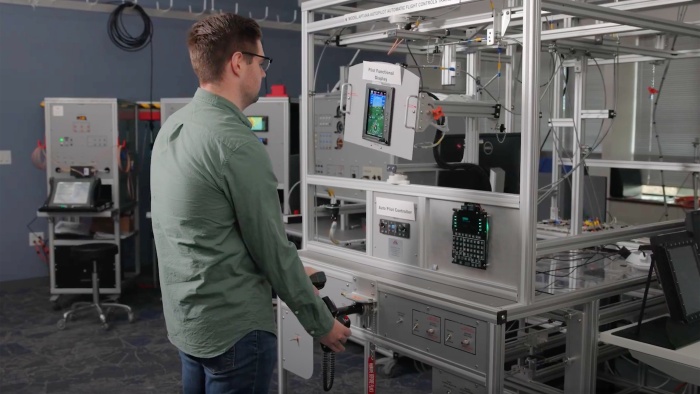


Publication
Strengthening America's Transportation Resilience: Innovating to Enhance Unified Response and Recovery
Media Coverage
Boston Globe: Defending Against Drones

Publication
Toward Resiliency in U.S. Critical Supply Chains
Publication
Autonomous Systems and Counter-Autonomy: Positioning the U.S. for Economic and Security Advantage
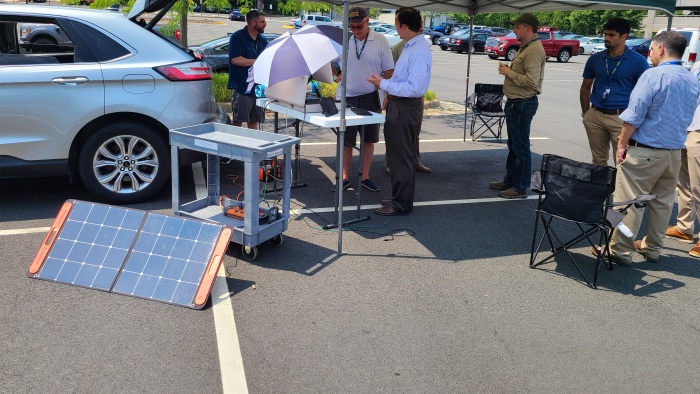
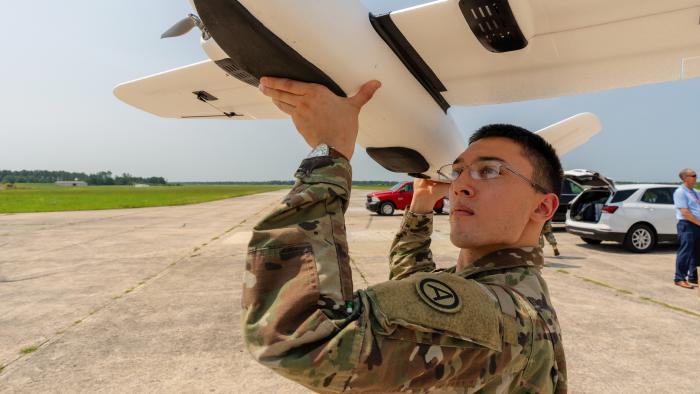
News Release
MITRE Licenses CARPE Dronvm Technology to AeroParagon for Advanced Drone Detection and Response

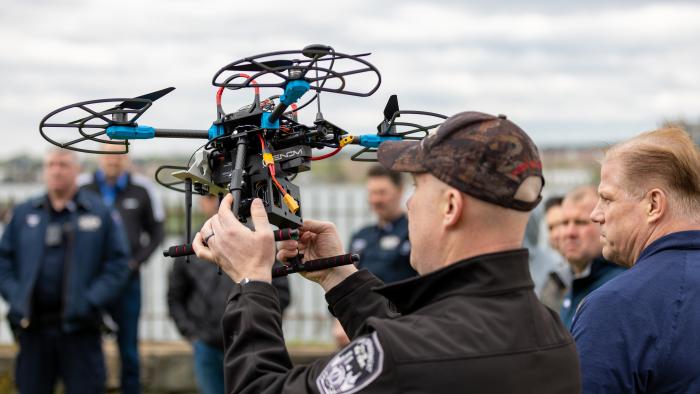
Media Coverage
Police Chief Magazine: In the Line of Fire

Fact Sheet
MITRE EDGE Lab
News Release
MITRE CTO Testifies on Critical Infrastructure Resilience at Congressional Hearing on Securing the Water Sector
Impact Story
Managing Insider Threats is a Team Sport

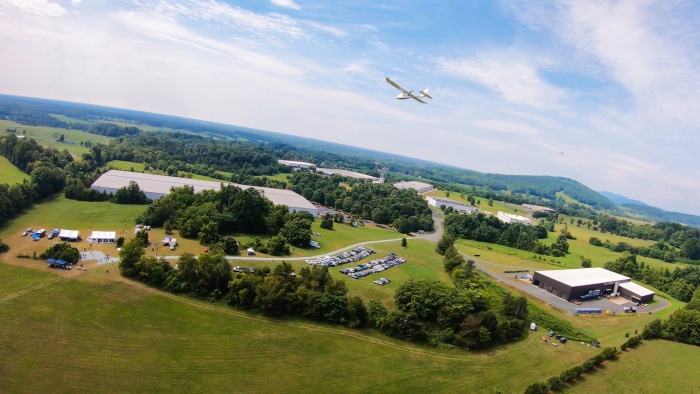
HSSEDI
The Homeland Security Systems Engineering and Development Institute™ (HSSEDI) drives discoveries that improve our nation’s safety and make our institutions more resilient in the face of threats.
